| TubeRadioLand:Home > Emerson > 109 |
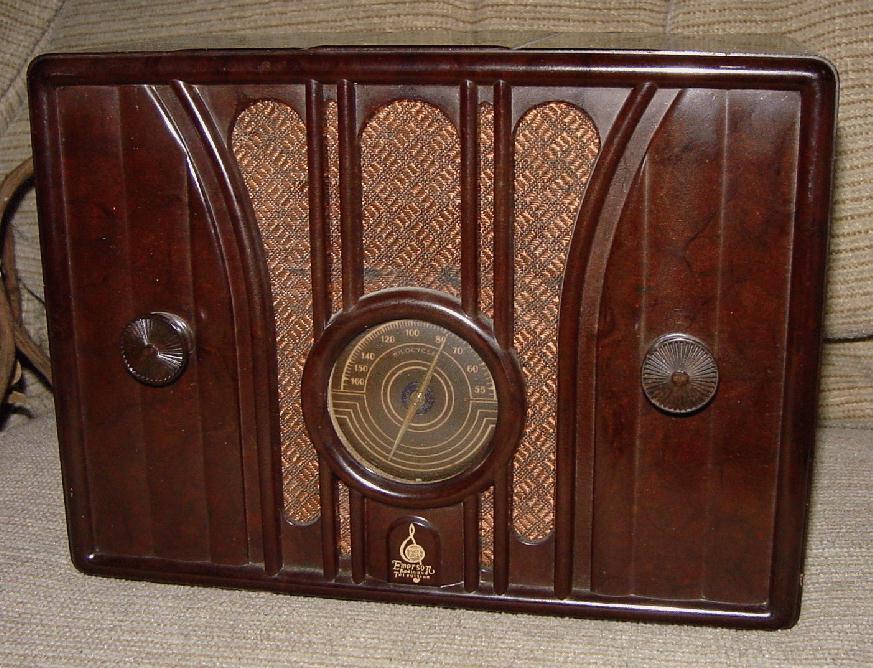
Emerson Model 109 Bakelite Table Radio (1935)
The Emerson model 109 was introduced in the
summer of 1935, priced at $14.95 complete with
"RCA tubes". It was part of Emerson's new line
for the 1935/1936 model season. The 109 is a
4-tube superhet tuning standard broadcast from
530-1620kc and using Emerson's U4A chassis.
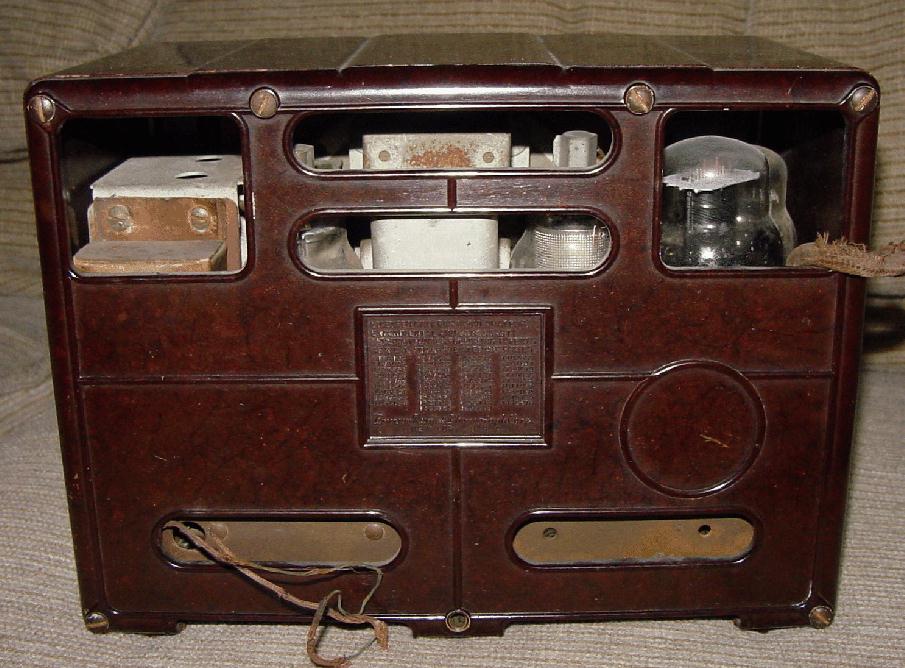
The tube line-up is 6A7 (LO/mixer), 6F7 (IF amp
& 2nd detector), 43 (power amp) and 25Z5
(rectifier). The 6F7 tube incorporates a triode
and a variable-mu pentode, sharing a common
cathode, into a single envelope. The schematic
may be found here, courtesy of NostalgiaAir.
Model 109 uses a resistance line cord ("curtain
burner") to drop line voltage to the level required
by the series-connected filament string.
Approximately 14W is dissipated in the line cord.
The advice at the time was that when the radio
was in use the cord should be unravelled and
stretched out to allow adequate heat dissipation
and ensure minimal temperature rise. The
problem was that owners would sometimes
overlook this and have the line cord coiled up
beneath a household item such as a curtain. The
heat build-up supposedly resulted in numerous
house fires - hence the name "curtain burner".
Use of these cords was soon discontinued by the
radio industry for safety reasons!
summer of 1935, priced at $14.95 complete with
"RCA tubes". It was part of Emerson's new line
for the 1935/1936 model season. The 109 is a
4-tube superhet tuning standard broadcast from
530-1620kc and using Emerson's U4A chassis.
The tube line-up is 6A7 (LO/mixer), 6F7 (IF amp
& 2nd detector), 43 (power amp) and 25Z5
(rectifier). The 6F7 tube incorporates a triode
and a variable-mu pentode, sharing a common
cathode, into a single envelope. The schematic
may be found here, courtesy of NostalgiaAir.
Model 109 uses a resistance line cord ("curtain
burner") to drop line voltage to the level required
by the series-connected filament string.
Approximately 14W is dissipated in the line cord.
The advice at the time was that when the radio
was in use the cord should be unravelled and
stretched out to allow adequate heat dissipation
and ensure minimal temperature rise. The
problem was that owners would sometimes
overlook this and have the line cord coiled up
beneath a household item such as a curtain. The
heat build-up supposedly resulted in numerous
house fires - hence the name "curtain burner".
Use of these cords was soon discontinued by the
radio industry for safety reasons!
4-tube AC-DC Super Heterodyne ... Illuminated Aeroplane Dial ... Dust-Proof Dynamic
Speaker ... Audio Overload Control.
Speaker ... Audio Overload Control.
Copyright TubeRadioLand.com