| TubeRadioLand:Home > Others > Echophone S4 |
Echophone S4 Cathedral Radio "The Bantam" (1930)
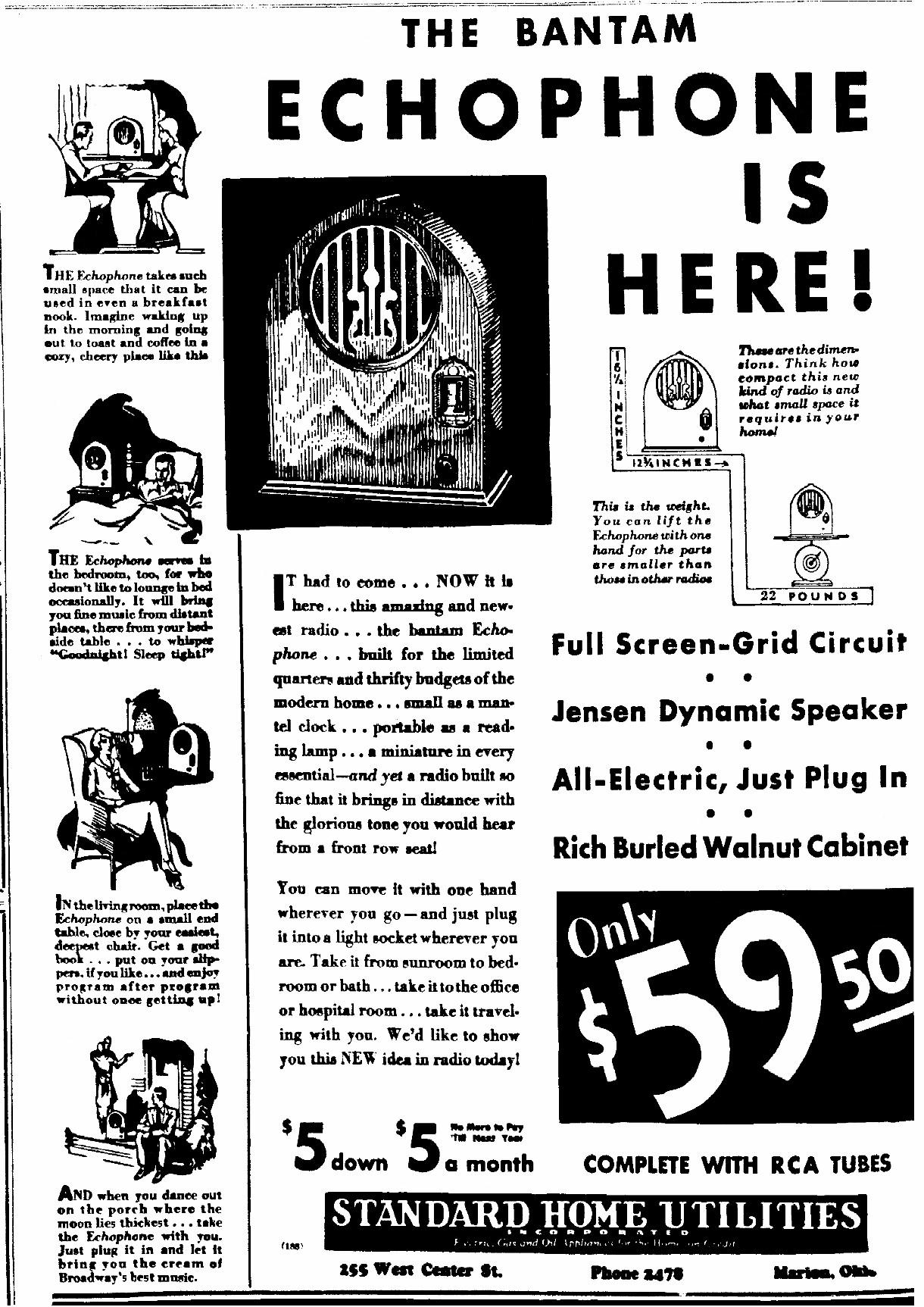
...built for the limited quarters and thrifty budgets of the modern home.
..the NEW idea in radio. Small as a clock, compact as a watch,
portable as a lamp.
portable as a lamp.
"Full Screen-Grid circuit .. All Electric .. Rich
Burled Walnut Cabinet"
Burled Walnut Cabinet"
The Echophone model S4 is a 6-tube ac-powered TRF rec-
eiver that tunes the standard broadcast band. It continued the
Echophone company's pioneering line of compact "Bantam"
sets that debuted a year or so earlier. They were amongst the
very first such sets offered to the public, appearing in the
marketplace some while before even the ubiquitous Philco 20,
one of the most famous of all such radios. Compacts were so
named because they combined loudspeaker and electronics
into one table-top cabinet that was considerably smaller than
the normal sets of the day. The S4 was priced at $59.50
complete with tubes.
The 1930/31 Echophone Bantams were smaller, lighter and
less expensive than the Philco model 20, and although they
were prominently advertised and appeared to have sold quite
well, they never achieved the sales success of the model 20.
In fact, by 1934 Echophone was out of business and its
assets were acquired by Hallicrafters. This seems to be an all-
too-often told story - that of a group of innovators who con-
ceive of a revolutionary new product, only to watch their idea
turn into a runaway commercial success in the hands of
others.
Echophone promoted the Bantam by describing it as "the new
idea in radio". A selection of extracts from 1930 newspaper
advertising may be found lower down on this page.
Echophone was based in Chicago and in 1934 the Corpora-
tion was purchased by Bill Halligan, who used the assets to
found the Hallicrafters Company. Hallicrafters went on to
produce affordable home and HAM equipment right through
to the late 50's, practically the end of the tube radio era.
Technical Details
The S4's 6-tube chassis used three of the latest screen grid
types, the line-up being 24+24 (2 stages of RF amplification),
24 (2nd detector), 27 (1st af), 45 (af power amp) & 80 (rect-
ifier). The schematic is here, courtesy of NostalgiaAir.
Tuning is by means of a thumbwheel, with the dial scale
graduated from 0 to 100. The lower knob on the front panel
controls the volume, using a potentiometer located in the
antenna circuit (there is no AVC). The on/off switch is at the
rear of the chassis and as was the case with most early sets,
it was not combined with any other function; it would be a year
or two before this switch would be almost universally combin-
ed with either the volume or tone control. The set uses an
electro-dynamic loudspeaker that was manufactured by
Jensen.
There are three connectors at the rear of the chassis, one for
ground, one for a "short antenna" and the third for a "long
antenna". Curiously, the only difference between the two ant-
enna inputs is that the "long" one inserts a 0.0001uF series
capacitor. The idea behind this "short" and "long" different-
iation is unclear.
eiver that tunes the standard broadcast band. It continued the
Echophone company's pioneering line of compact "Bantam"
sets that debuted a year or so earlier. They were amongst the
very first such sets offered to the public, appearing in the
marketplace some while before even the ubiquitous Philco 20,
one of the most famous of all such radios. Compacts were so
named because they combined loudspeaker and electronics
into one table-top cabinet that was considerably smaller than
the normal sets of the day. The S4 was priced at $59.50
complete with tubes.
The 1930/31 Echophone Bantams were smaller, lighter and
less expensive than the Philco model 20, and although they
were prominently advertised and appeared to have sold quite
well, they never achieved the sales success of the model 20.
In fact, by 1934 Echophone was out of business and its
assets were acquired by Hallicrafters. This seems to be an all-
too-often told story - that of a group of innovators who con-
ceive of a revolutionary new product, only to watch their idea
turn into a runaway commercial success in the hands of
others.
Echophone promoted the Bantam by describing it as "the new
idea in radio". A selection of extracts from 1930 newspaper
advertising may be found lower down on this page.
Echophone was based in Chicago and in 1934 the Corpora-
tion was purchased by Bill Halligan, who used the assets to
found the Hallicrafters Company. Hallicrafters went on to
produce affordable home and HAM equipment right through
to the late 50's, practically the end of the tube radio era.
Technical Details
The S4's 6-tube chassis used three of the latest screen grid
types, the line-up being 24+24 (2 stages of RF amplification),
24 (2nd detector), 27 (1st af), 45 (af power amp) & 80 (rect-
ifier). The schematic is here, courtesy of NostalgiaAir.
Tuning is by means of a thumbwheel, with the dial scale
graduated from 0 to 100. The lower knob on the front panel
controls the volume, using a potentiometer located in the
antenna circuit (there is no AVC). The on/off switch is at the
rear of the chassis and as was the case with most early sets,
it was not combined with any other function; it would be a year
or two before this switch would be almost universally combin-
ed with either the volume or tone control. The set uses an
electro-dynamic loudspeaker that was manufactured by
Jensen.
There are three connectors at the rear of the chassis, one for
ground, one for a "short antenna" and the third for a "long
antenna". Curiously, the only difference between the two ant-
enna inputs is that the "long" one inserts a 0.0001uF series
capacitor. The idea behind this "short" and "long" different-
iation is unclear.
| "...the new radio that... Is small... as a mantel clock, compact as a watch..yet a truly fine radio. Is portable... so you can carry it from room to room, plug it in anywhere you are... This is the NEW idea in radio." "It is ALL-IN-ONE - No larger than a loud speaker - No heavier than a suitcase. Best of all, it is not an ORPHAN - it is the creation of one of the finest radio factories in America. New and reliable in every detail" "It had to come.... NOW it is here... this amazing new radio...the Bantam Echophone....built for the limited quarters and thrifty budgets of the modern home... small as a mantel clock...portable as a reading lamp...a miniature in every essential - and yet a radio built so fine that it brings in distance with the glorious tone you would hear from a front row seat." "You can move it with one hand wherever you go - and just plug it into any light socket wherever you are. Take it from sunroom to bedroom or bath... take it to the office or hospital room...take it travelling with you.." |
Dec 3rd 1930, Ohio
Copyright TubeRadioLand.com