| TubeRadioLand:Home > Emerson > BD-197 |
Emerson unveiled their line-up for the 1939
season, which included the BD-197 "Mae
West", at a showing held in the Hotel New
York between June 20th and 24th of 1938.
The "Mae West" was priced at $39.95.
Perhaps understandably, the BD-197 has
always been a controversial radio. I'm not sure
when it first earned its nickname (the rationale
for which needs no elaboration!), but would
guess that it was years ago. Robert Hawes, in
his book Radio Art, refers to it as "a grotesque
table radio in bent plywood". That however is
an extreme assessment, for risque though the
set may be, grotesque it surely is not. Howard
Stone, at stonevintageradio, questions "how
the designer of the radio sold the concept of
the radio case to management?". We may
never know the answer to that but there are
later hints as to the management's reaction in
that the model was sparsely advertised and
never produced in any volume. On the other
hand, the same could be said of any number
of other more traditional models too.
The Emerson BD-197 "Mae West" was styled
by Count Alexis de Sakhnoffsky, a controver-
sial and ultimately notorious personality of his
day (see story below). He became world re-
nowned for his curvy and streamlined designs.
A tidbit in a March 1938 edition of the New
York Times announced that Emerson enlisted
the services of Sakhnoffsky in early 1938, just
a few months before the Mae West was intro-
duced to the marketplace. The Count was
known for the blazing speed at which he
turned out some of his designs. He not only
styled this set, but also the contemporaneous
models AX-211, AX-212 and AU-213, to men-
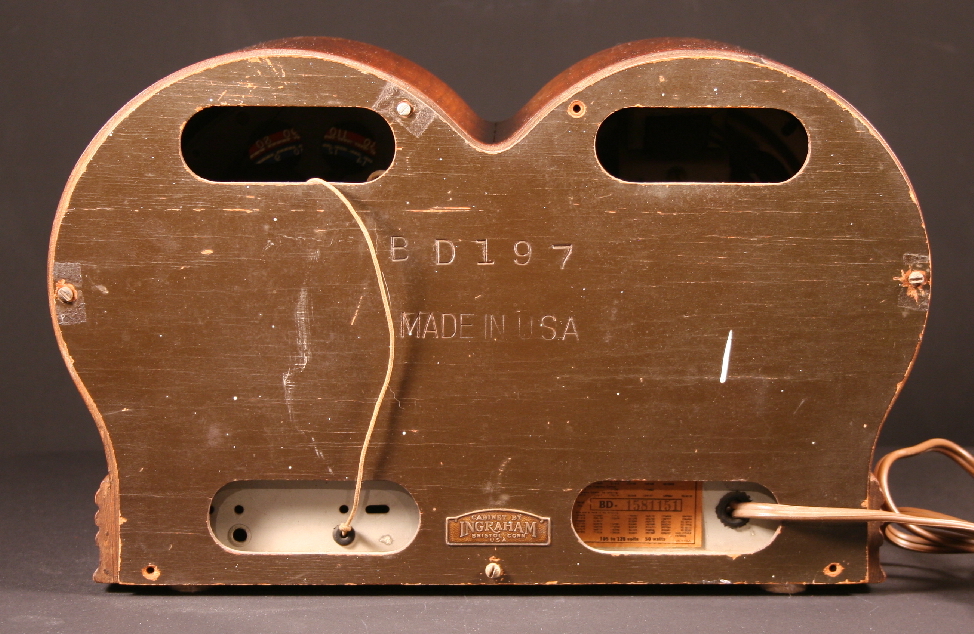
tion a few. For his wooden sets, the "stay-
bent" cabinets were manufactured by the
Ingraham Co. of Connecticut, an appropriate
choice given their extreme curvaceousness.
The Mae West employs Emerson's "Miracle
Dial" or "visual cone". It was touted by the
company as "readable from any standing or
sitting position". Was this an effort to spin an
aura of respectability onto the radio? The
dial is attributed in Emerson advertising to
Sakhnoffsky and was used on a number of
models, so it's likely he styled the cabinets
for the other sets using this dial too.
season, which included the BD-197 "Mae
West", at a showing held in the Hotel New
York between June 20th and 24th of 1938.
The "Mae West" was priced at $39.95.
Perhaps understandably, the BD-197 has
always been a controversial radio. I'm not sure
when it first earned its nickname (the rationale
for which needs no elaboration!), but would
guess that it was years ago. Robert Hawes, in
his book Radio Art, refers to it as "a grotesque
table radio in bent plywood". That however is
an extreme assessment, for risque though the
set may be, grotesque it surely is not. Howard
Stone, at stonevintageradio, questions "how
the designer of the radio sold the concept of
the radio case to management?". We may
never know the answer to that but there are
later hints as to the management's reaction in
that the model was sparsely advertised and
never produced in any volume. On the other
hand, the same could be said of any number
of other more traditional models too.
The Emerson BD-197 "Mae West" was styled
by Count Alexis de Sakhnoffsky, a controver-
sial and ultimately notorious personality of his
day (see story below). He became world re-
nowned for his curvy and streamlined designs.
A tidbit in a March 1938 edition of the New
York Times announced that Emerson enlisted
the services of Sakhnoffsky in early 1938, just
a few months before the Mae West was intro-
duced to the marketplace. The Count was
known for the blazing speed at which he
turned out some of his designs. He not only
styled this set, but also the contemporaneous
models AX-211, AX-212 and AU-213, to men-
tion a few. For his wooden sets, the "stay-
bent" cabinets were manufactured by the
Ingraham Co. of Connecticut, an appropriate
choice given their extreme curvaceousness.
The Mae West employs Emerson's "Miracle
Dial" or "visual cone". It was touted by the
company as "readable from any standing or
sitting position". Was this an effort to spin an
aura of respectability onto the radio? The
dial is attributed in Emerson advertising to
Sakhnoffsky and was used on a number of
models, so it's likely he styled the cabinets
for the other sets using this dial too.
Emerson BD-197 "Mae West" Table Radio (1938-1939)


...only dial of its kind... "visual cone" ingeniously devised to be read from any standing or sitting position.
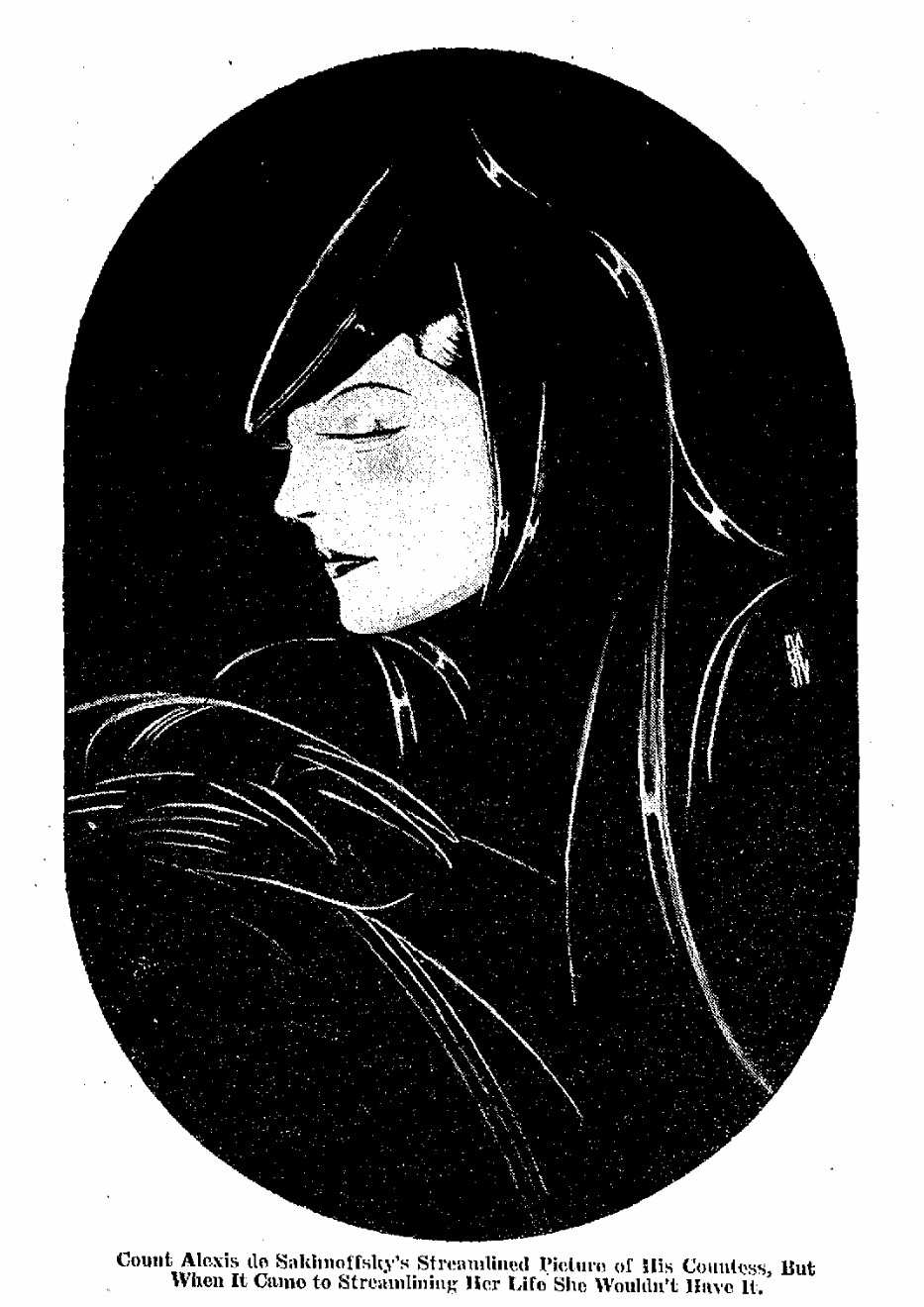
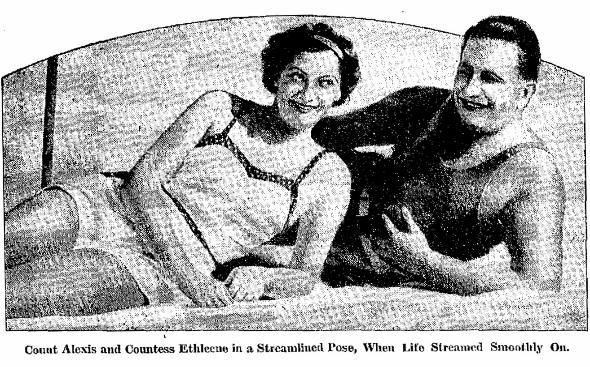
| Count Sakhnoffsky was born in Russia in 1901, and after emigrating to Switzerland, where he styled automobiles, in the late 1920s he immigrated to the United States. He soon became famous for his streamlined automobile designs and subsequently for streamlining everything, from eggbeaters to furniture to automobiles. In 1934 he joined Esquire as Technical Editor and the magazine became a popular showcase for his drawings and ideas. In early 1938 he was retained by the Emerson Radio & Phono- graph Corp to design a series of radio cabinets, the most famous being the Mae West. The Count became a world authority on the curvaceous and streamlined designs for automobiles, trailers, bicycles, planes, boats, radios, domestic appliances, furniture and even wristwatches. In 1935 he styled the "Curvex Watch", claimed to be "the world's first truly curved wrist watch". It was sold under the advertising catch-phrase "your curved wrist deserves the world's only truly curved watch". As we shall now see, curves and streamlining played a big role in the Count's private life too. In 1935 in New York Count Alexis married Phoebe Ethleene Frasier following a 15 month romance, his bride becoming known as the Countess Ethleene Sakhnoffsky. The Count hoped that the Countess would grow to love curves and streamlining as much as he did. To encourage her once it appeared she was not interested, he drew a portrait of her in a highly streamlined pose and hung it in their home (see below left). He added what he thought were strong hints to the portrait, intended to suggest to his Countess how she could become a more streamlined person. The French author Claude Robert had written "streamlining is to the engineer what strawberries are to cream. Everything today is streamlined, from the human chassis to the eggbeater". Aware as the Countess was of such writings, she nevertheless did not see the portrait as containing the slightest hint, refusing to be streamlined by her talented and artistic but scheming husband. The Count would eventually unkindly comment that she con- veyed to him "the impression of an unstreamlined refrigerator". One day, after gazing up at the portrait, the Countess happened to notice scraps of a letter in a nearby garbage can. Following her woman's intuition, she pieced the frag- ments together and found out that the letter, which began "Dear Harmony", had been written by her husband in reply to a woman who had responded to a personal ad that he had placed in a newspaper. The ad, which the Countess expended some effort in tracking down, read "Companion wanted by continental gentleman with private means and open auto". Apparently the Count never mailed the letter, carelessly disposing of it instead in the garbage, where the Countess later found it. It included the paragraph "I prefer ash blondes and red heads, but have had many enjoyable moments with brun- ettes. Hate very short, very thin and muscular women". All at once, the Countess bel- ieved she had the explanation for her husbands absences, missed luncheon appoint- ments and his ever increasing detachment. Once confronted, the Count boasted to the Countess, without the slightest inhibition, that he was in love with a woman, a blonde artist, and that he intended to live with her and go to Mexico with her to study Aztec art for ideas to incorporate into modern design. In early 1941 the Countess sued for divorce, stating that her husband had left her three months earlier for a "buxom and voluptuous blonde" (she was never identified). She added that her husband had switched his attitude towards her before the honey- moon was even over. Their 15 months of courtship had been the "perfect romance", during which they "rode the clouds of happiness together" with him playing a "prince charming fresh from the pages of a story book". When away on travel, "he had flowers delivered every day, beautiful, white, roses and orchids". On their grand honeymoon in Europe it became evident that the Count was not as advertised. During divorce proc- eedings in Los Angeles, the Countess charged cruelty and desertion, stating that even on the honeymoon "there was a rapid change from a romantic lover to a husband who looked upon me as a chattel, as property, as just something secondary in his life". The newspapers at the time of course pounced on the scandal, running headlines such as "Streamliner Count Alexis' Struggle with Unstreamlined Love". Newsprint treatises followed, analyzing how it had come to pass that the Countess had lost the attentions of her husband, and advising women "not to attempt to tame their husbands" and on how to "hang onto their man". Another report neatly summarized the whole affair by stating "designing streamlined refrigerators and autos was perfectly all right, but when he discovered the streamlined blonde his unstreamlined wife rebelled and the Judge, after getting all the angles, streamlined the Count's bankroll to fill up her financial curves". So there we have it. Is it now any surprise that the womanizing Sakhnoffsky, self-professed admirer of buxom and voluptuous blondes and world authority on curves and streamlining, came up with the risque styling for a radio such as Emerson's BD-197 "Mae West"? See Kris Walter's BD-197 webpage for some additional insights into this matter. |
| Count Alexis de Sakhnoffsky ...who had a hankering for "buxom and voluptuous blondes" |

| AC-DC Superheterodyne. American, Foreign, Police. "Duo-Vue" Model... readable from any standing or sitting position. Walnut cabinet. |
Bibliography:
"Advertising Notes: Emerson Adds Feature New
Model", NY Times, March 12th 1938
"Streamliner Count Alexis' Struggle With
UnStreamlined Love", San Antonio Light, June 1st,
1941, pg75
"Don't Try to Tame Your Husband", Albuquerque
Journal, May 11th 1941, pg 19
"Advertising Notes: Emerson Adds Feature New
Model", NY Times, March 12th 1938
"Streamliner Count Alexis' Struggle With
UnStreamlined Love", San Antonio Light, June 1st,
1941, pg75
"Don't Try to Tame Your Husband", Albuquerque
Journal, May 11th 1941, pg 19
Copyright TubeRadioLand.com
The BD-197 is a two waveband 6-tube
AC-DC superheterodyne receiver. Band
coverage is from 540-1730 and 5600-18000
kcs. The tube line-up is 6A7 (mixer/LO), 6D6
(IF amp), 6Q7 (2nd detector/1st AF/AVC),
25L6 (AF output), 25Z5 (rectifier) and
3CR-241 (ballast tube). The schematic is
available here, courtesy of NostalgiaAir.
AC-DC superheterodyne receiver. Band
coverage is from 540-1730 and 5600-18000
kcs. The tube line-up is 6A7 (mixer/LO), 6D6
(IF amp), 6Q7 (2nd detector/1st AF/AVC),
25L6 (AF output), 25Z5 (rectifier) and
3CR-241 (ballast tube). The schematic is
available here, courtesy of NostalgiaAir.
"Cultivate your curves - they may be
dangerous but they won't be avoided"
Mae West
For more Mae West quotes, see here.
dangerous but they won't be avoided"
Mae West
For more Mae West quotes, see here.
Copyright TubeRadioLand.com