| TubeRadioLand:Home > Others > Fada 115 |
Fada Catalin Model 115 "Bullet" Radios (1940)

Gems of the Radio Industry. Beautiful!... Exquisite!... Handsome!... Gorgeous!... Gem-like!... Harmonizing!
The Fada model 115 "streamliner" or
"bullet" radios are widely considered to
be amongst the finest design classics
of the mid-century tube radio era. And
it's not difficult to see why, as what a
feast for the eyes do these little sets
render! Originally available in five
fabulous color combinations, they
stand out from the somber ranks of the
more traditional radios of the day, just
like gemstones, resplendent upon an
otherwise dull and rocky beach.
The 115 was introduced in the summer
or early fall of 1940 as part of the line-
up for Fada's 1941 model season. The
list price was $19.95 for all variants.
"bullet" radios are widely considered to
be amongst the finest design classics
of the mid-century tube radio era. And
it's not difficult to see why, as what a
feast for the eyes do these little sets
render! Originally available in five
fabulous color combinations, they
stand out from the somber ranks of the
more traditional radios of the day, just
like gemstones, resplendent upon an
otherwise dull and rocky beach.
The 115 was introduced in the summer
or early fall of 1940 as part of the line-
up for Fada's 1941 model season. The
list price was $19.95 for all variants.
| "Outstanding among the many new FADA 1941 models are these eye-thrilling, colorful radios. The chassis is a powerful 5 tube superheterodyne with 7 tube performance, operating on either AC or DC current. The set has its own built-in FA-DA-SCOPE LOOP ANTENNA. The convenient DROP HANDLE makes it easy to carry from room to room. For STYLE and BEAUTY these GEM-LIKE CABINETS are breath-taking in appearance. They resemble such precious stones such as Onyx, Alabaster, Ruby and Lapis Lazuli. Your choice of 5 color combinations are listed" |
| Model 115A - All Alabaster Cabinet. Model 115AR - Alabaster Cabinet with Red Appointments Model 115XA - Onyx Cabinet with Alabaster Appointments Model 115MA - Ruby-like maroon cabinet with Alabaster Appointments Model 115BA - Blue Lapis Lazuli Cabinet with Alabaster Appointments |
| Technical Details |
The 115 uses an "All American Five"
chassis that tunes the standard
broadcast band. The tube line-up is
12SA7(GT), 12SK7(GT), 12SQ7(GT),
50L6GT and 35Z5GT. Schematic.
chassis that tunes the standard
broadcast band. The tube line-up is
12SA7(GT), 12SK7(GT), 12SQ7(GT),
50L6GT and 35Z5GT. Schematic.
In perusing the list of available color
combinations listed in the ad snippet
above, there is no mention of yellow or
butterscotch. So how does one explain
the coloring of the trim on the second
and third or the base color of the first
of the models shown to the right? The
answer is that the model 115 is cons-
tructed of catalin, an early plastic whose
colorfastness is notoriously unstable.
When exposed to natural levels of ultra-
violet light over a period of years, the
surface layer of original alabaster col-
oring progressively "ages" to butter-
scotch, while blue turns a dark greenish
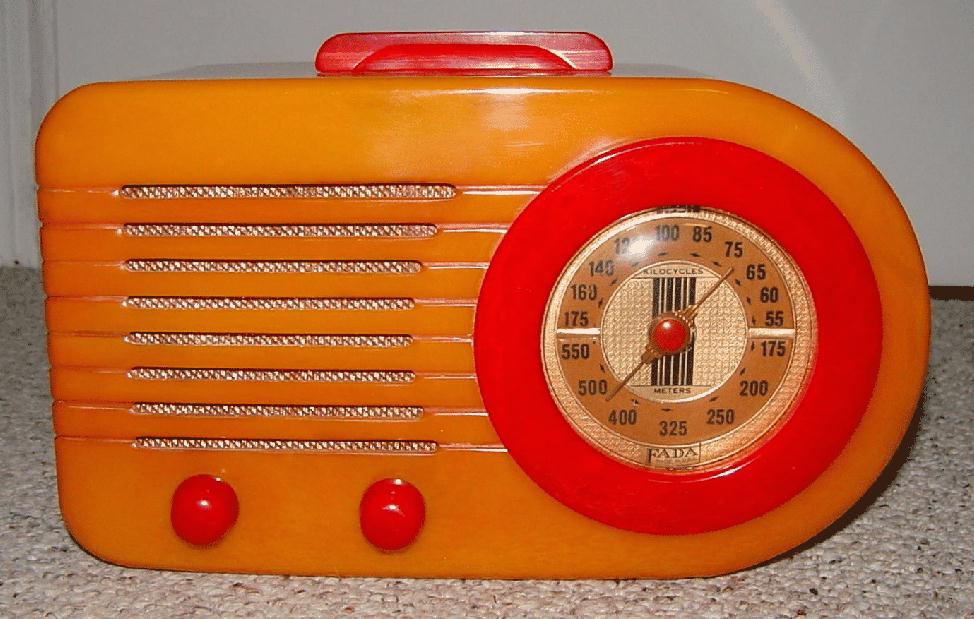
brown (olive-like). Thus my model 115AR
(upper) now has a butterscotch cabinet
and my 115BA (mid) and 115XA (lower)
have butterscotch trim instead of
alabaster. The 115BA would have had a
drab olive-colored cabinet had it not
been sanded and/or polished to remove
the surface discoloration and restore the
original, vibrant "lapis lazuli" blue color.
My 115AR could likewise have been treat-
ed to restore its original cabinet color too,
but I've chosen to leave it be. I think it
looks better as is.
To the right, is a cutting pertaining to
Fada's 1940 line, found in a late 1939
newspaper. I've included it here as it
remained applicable to the company's
1941 models also.
Read about precious stones Lapis Lazuli and
Alabaster.
combinations listed in the ad snippet
above, there is no mention of yellow or
butterscotch. So how does one explain
the coloring of the trim on the second
and third or the base color of the first
of the models shown to the right? The
answer is that the model 115 is cons-
tructed of catalin, an early plastic whose
colorfastness is notoriously unstable.
When exposed to natural levels of ultra-
violet light over a period of years, the
surface layer of original alabaster col-
oring progressively "ages" to butter-
scotch, while blue turns a dark greenish
brown (olive-like). Thus my model 115AR
(upper) now has a butterscotch cabinet
and my 115BA (mid) and 115XA (lower)
have butterscotch trim instead of
alabaster. The 115BA would have had a
drab olive-colored cabinet had it not
been sanded and/or polished to remove
the surface discoloration and restore the
original, vibrant "lapis lazuli" blue color.
My 115AR could likewise have been treat-
ed to restore its original cabinet color too,
but I've chosen to leave it be. I think it
looks better as is.
To the right, is a cutting pertaining to
Fada's 1940 line, found in a late 1939
newspaper. I've included it here as it
remained applicable to the company's
1941 models also.
Read about precious stones Lapis Lazuli and
Alabaster.
"115XA. Onyx with Alabaster"
Radio Retailing, Sept 1940
| "Plug In, Play" Fada Slogan. Portable Boasting Built-In Antenna is Featured The 1940 Fada radios are so equipped the owner may "plug in and play them anywhere". This is made possible by the built-in antenna which also resists man-made static. Many table models are constructed with handles so the set may be easily picked up and carried wherever the owner desires. This portable feature is added without interfering with the appearance of the set. In fact, the pick-up feature is designed into many numbers cabinetted in colorful Catalin which gives off the appearance of precious jewels. |
"...eye-thrilling, colorful radios"

"115AR. Alabaster with Red"
"115BA. Blue Lapis Lazuli with Alabaster"
Copyright TubeRadioLand.com

Radio Retailing, Sept 1940