Majestic (Grigsby-Grunow) 59 'Studio' Tombstone Radio (1933)
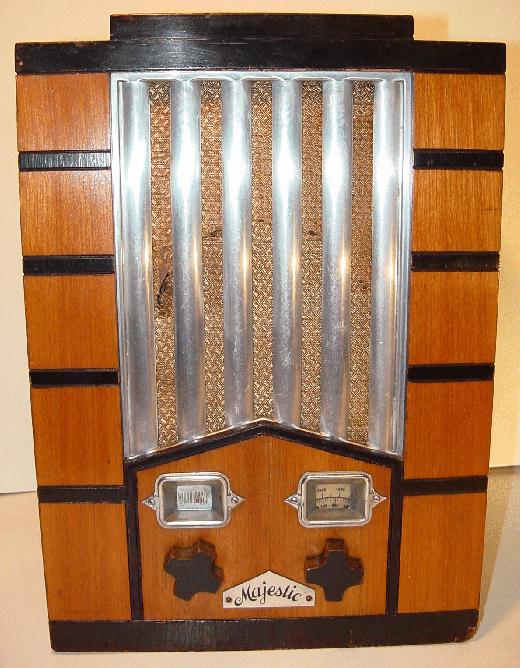
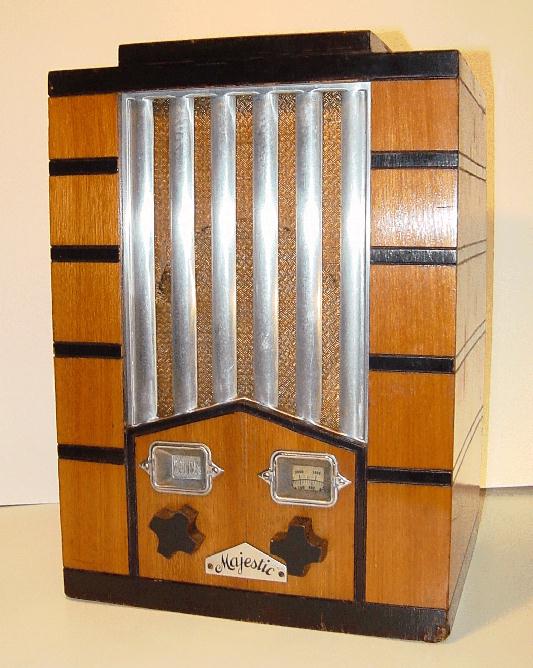
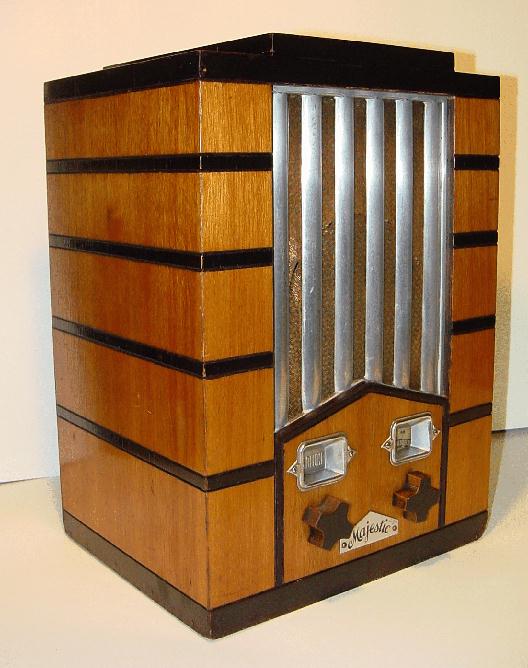
The Majestic model 59 "studio" is a compact but highly
collectible depression era tombstone radio. With its
finely polished aluminium grille bars, twin escutcheons,
contrasting two-tone veneers and machine-like knobs it
truly has a majestic appearance that screams "art deco"
whichever way you look at it!
It covers two bands, standard broadcast (535-1550kc)
and shortwave (1480-4440kc), selected using a switch
on the chassis at the rear. Precision tuning is achieved
through the use of a 5.5:1 planetary drive on the tuning
condensor.
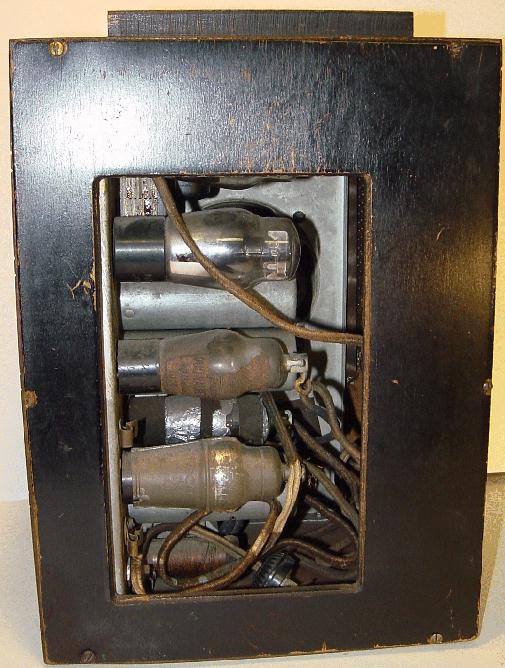
It features an interesting and somewhat unconventional
five-tube superhet chassis that has not one but two IF
stages. Because of its use of "duo" type tubes, its
five-tube line up is equivalent to many other
manufacturer's 6 and 7 tube receivers. The complement
is:- 6A7-S (LO/mixer), 6F7-S pentode/triode (1st IF amp
pentode/1st af amp triode), 6B7-S twin-diode/pentode
(2nd IF amp pentode/2nd detector diode/AVC diode),
42 (AF power amp), 80 rectifier.
The S designation on several of the tube types is taken
directly from the tube diagram attached inside the radio
and is also found on the schematic (see link below). It
signifies Majestic tube types having spray-on shielding
(see foot of page). Some of the original types are still
within this set!
The cabinet of this set is constructed from quarter-sliced
birch with two-tone finish - ebony and natural. The
original purchase price was $46.75, complete to the
aerial. An original Majestic ad featuring this model, from
Dec 1933, can be seen here. The schematic can be
found under Grigsby-Grunow Model 59 at NostalgiaAir.
Majestic was the trade name of the Grigsby-Grunow
Company of Chicago, which began making radios in
1928. Founded by the partners W. Grunow and B.
Grigsby, the company at first enjoyed meteoric success,
buoyed by its superior loudspeaker technology. By some
accounts, in 1929 it outsold all other radio
manufacturers. Unfortunately, in November of 1933, the
year of my model 59's manufacture, they were in
receivership and on February 20th of 1934 they were
declared bankrupt, another victim of over-reach and the
Great Depression. The company's name, however, was
resurrected as the Majestic Radio and TV Corporation,
which continued manufacturing and marketing radios
under the Majestic name until at least the middle fifties.
William Grunow had departed the company in 1931 to
form General Household Utilities, which made radios
under the Grunow name until 1937.
For more about the rise and fall of Grigsby-Grunow, see
my two-part article published in Antique Radio Classified:
part 1. part 2.
Reproduced below is a listing of the "advantages" of the
Majestic Spray-Shielding (called Seal-Shielding by the
Canadian Rogers Corporation who used the Majestic
tubes). Extracted from a Dec 1933 Canadian newspaper.
collectible depression era tombstone radio. With its
finely polished aluminium grille bars, twin escutcheons,
contrasting two-tone veneers and machine-like knobs it
truly has a majestic appearance that screams "art deco"
whichever way you look at it!
It covers two bands, standard broadcast (535-1550kc)
and shortwave (1480-4440kc), selected using a switch
on the chassis at the rear. Precision tuning is achieved
through the use of a 5.5:1 planetary drive on the tuning
condensor.
It features an interesting and somewhat unconventional
five-tube superhet chassis that has not one but two IF
stages. Because of its use of "duo" type tubes, its
five-tube line up is equivalent to many other
manufacturer's 6 and 7 tube receivers. The complement
is:- 6A7-S (LO/mixer), 6F7-S pentode/triode (1st IF amp
pentode/1st af amp triode), 6B7-S twin-diode/pentode
(2nd IF amp pentode/2nd detector diode/AVC diode),
42 (AF power amp), 80 rectifier.
The S designation on several of the tube types is taken
directly from the tube diagram attached inside the radio
and is also found on the schematic (see link below). It
signifies Majestic tube types having spray-on shielding

(see foot of page). Some of the original types are still
within this set!
The cabinet of this set is constructed from quarter-sliced
birch with two-tone finish - ebony and natural. The
original purchase price was $46.75, complete to the
aerial. An original Majestic ad featuring this model, from
Dec 1933, can be seen here. The schematic can be
found under Grigsby-Grunow Model 59 at NostalgiaAir.
Majestic was the trade name of the Grigsby-Grunow
Company of Chicago, which began making radios in
1928. Founded by the partners W. Grunow and B.
Grigsby, the company at first enjoyed meteoric success,
buoyed by its superior loudspeaker technology. By some
accounts, in 1929 it outsold all other radio
manufacturers. Unfortunately, in November of 1933, the
year of my model 59's manufacture, they were in
receivership and on February 20th of 1934 they were
declared bankrupt, another victim of over-reach and the
Great Depression. The company's name, however, was
resurrected as the Majestic Radio and TV Corporation,
which continued manufacturing and marketing radios
under the Majestic name until at least the middle fifties.
William Grunow had departed the company in 1931 to
form General Household Utilities, which made radios
under the Grunow name until 1937.
For more about the rise and fall of Grigsby-Grunow, see
my two-part article published in Antique Radio Classified:
part 1. part 2.
Reproduced below is a listing of the "advantages" of the
Majestic Spray-Shielding (called Seal-Shielding by the
Canadian Rogers Corporation who used the Majestic
tubes). Extracted from a Dec 1933 Canadian newspaper.
The Seven-Point Superiority of Seal-Shielding At no extra Cost
Seal-Shielding is exclusive to Rogers and Majestic |
Majestic. You have never seen such good-looking radios...
..a striking design in two-toned woods, with
shining metal grille.
shining metal grille.
| TubeRadioLand:Home > Majestic > 59 |
Copyright TubeRadioLand.com