| TubeRadioLand:Home > GE > J-80 |
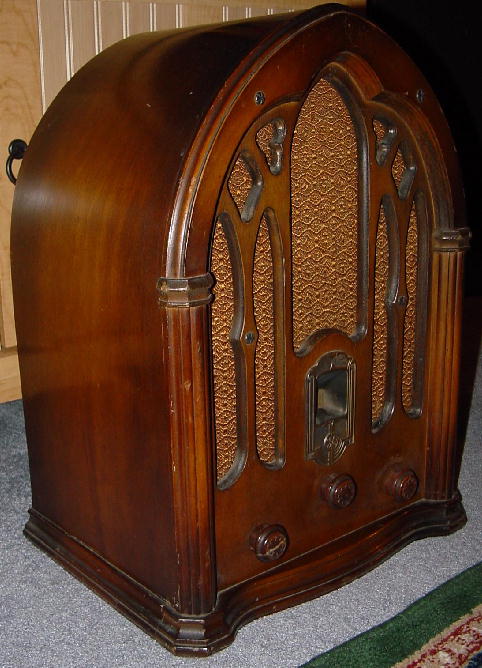
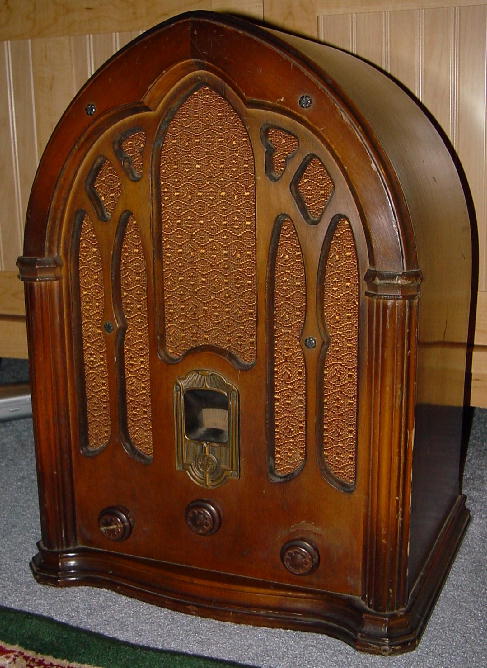
General Electric (GE) Model J-80 Cathedral Radio (1932)
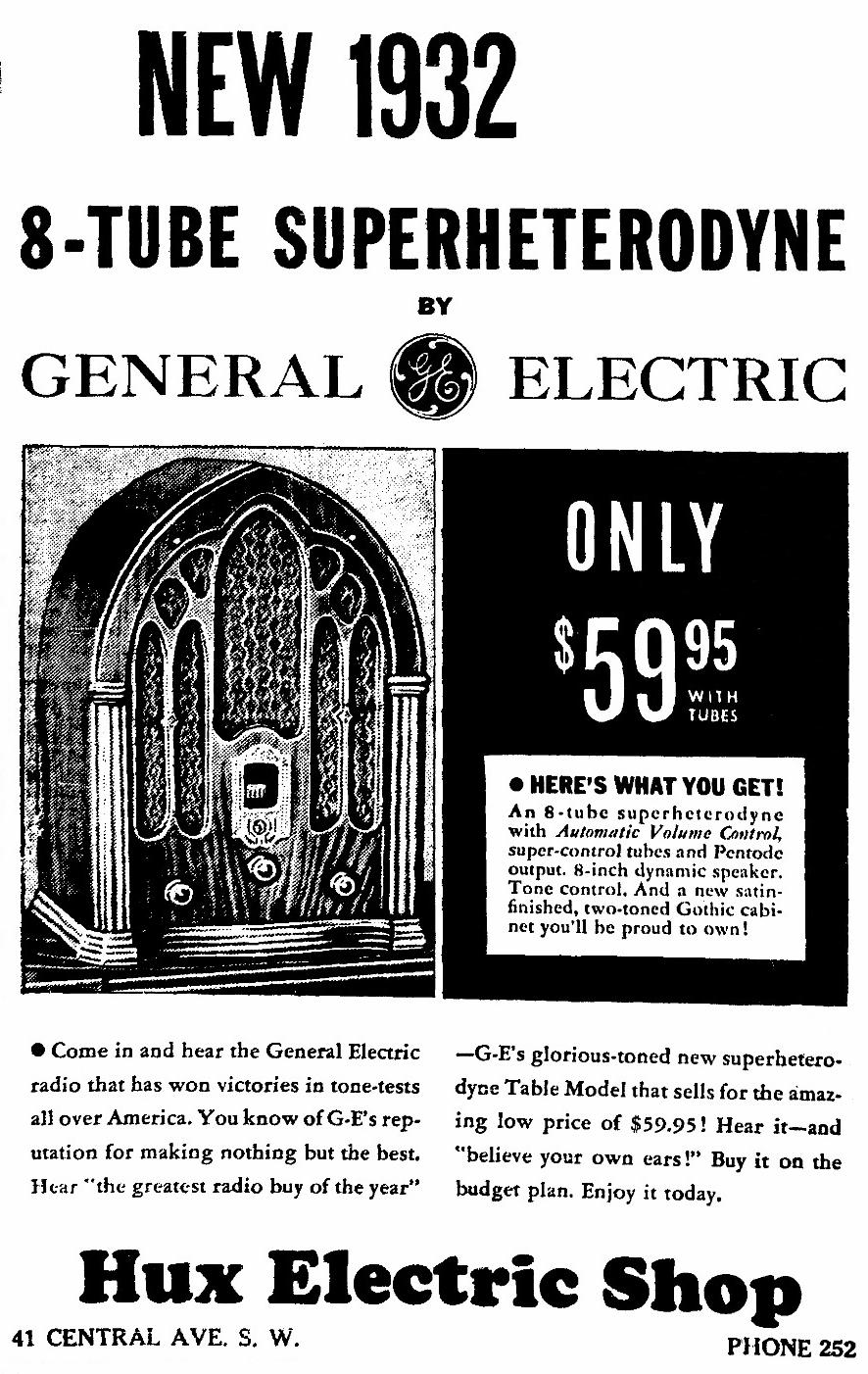
The General Electric (GE) model J-80 was described by
GE in their 1932 advertising as being "an early English
style compact" with "a new satin finished, two-toned
Gothic cabinet that you'll be proud to own". In my opin-
ion, their description is an understatement, for in real life
this radio portrays a truly stately visual quality that's diffi-
cult to capture in mere words. It's one of my very favorite
cathedral style radios.
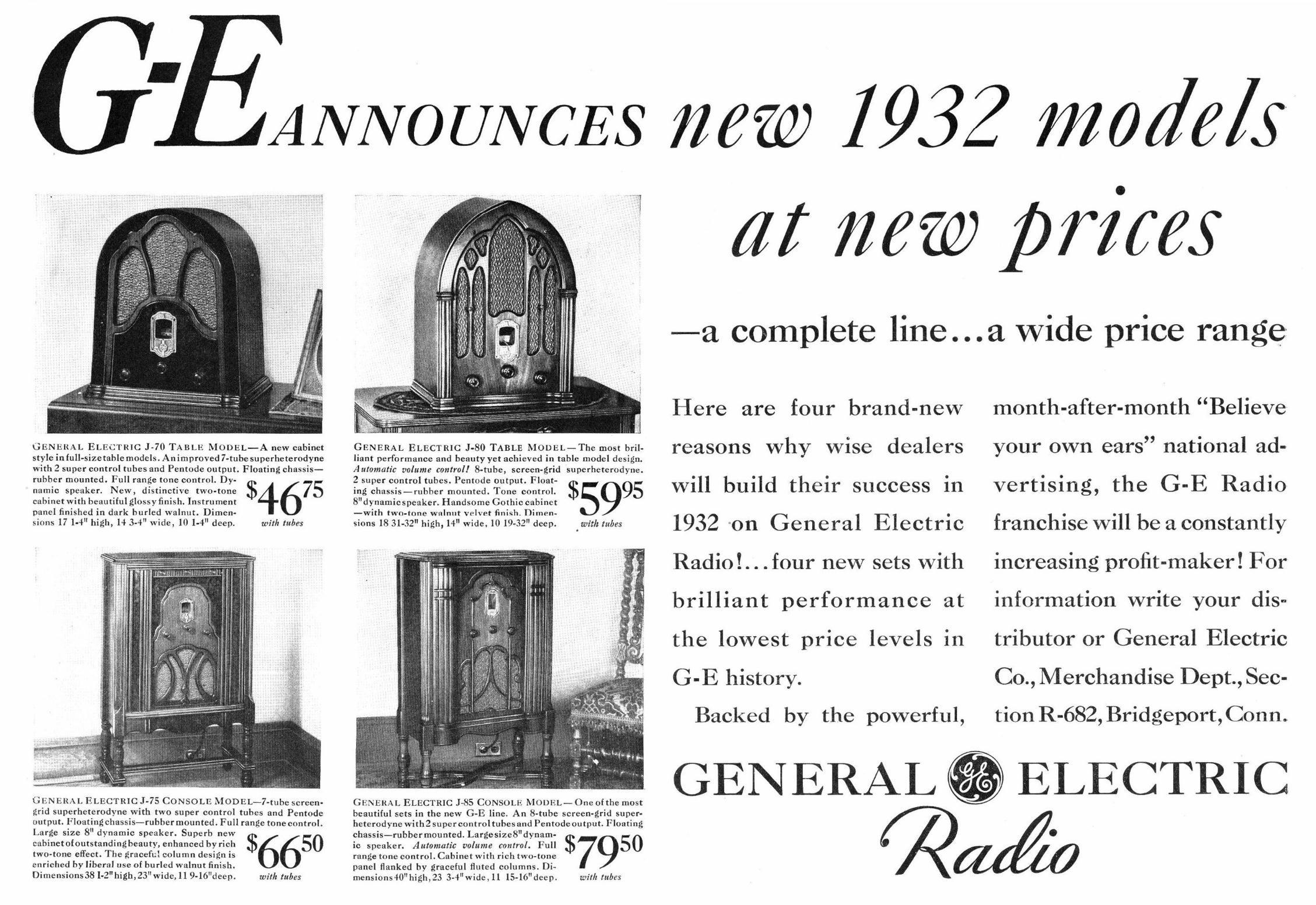
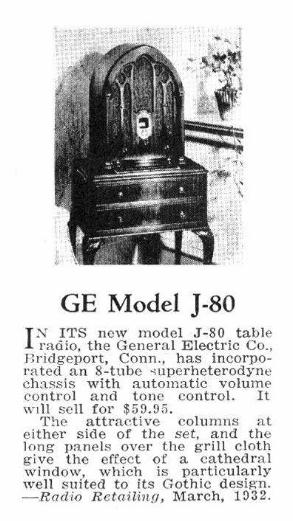
The J-80 was announced to the trade in the February
1932 edition of Radio-Retailing, priced at $59.95 in the
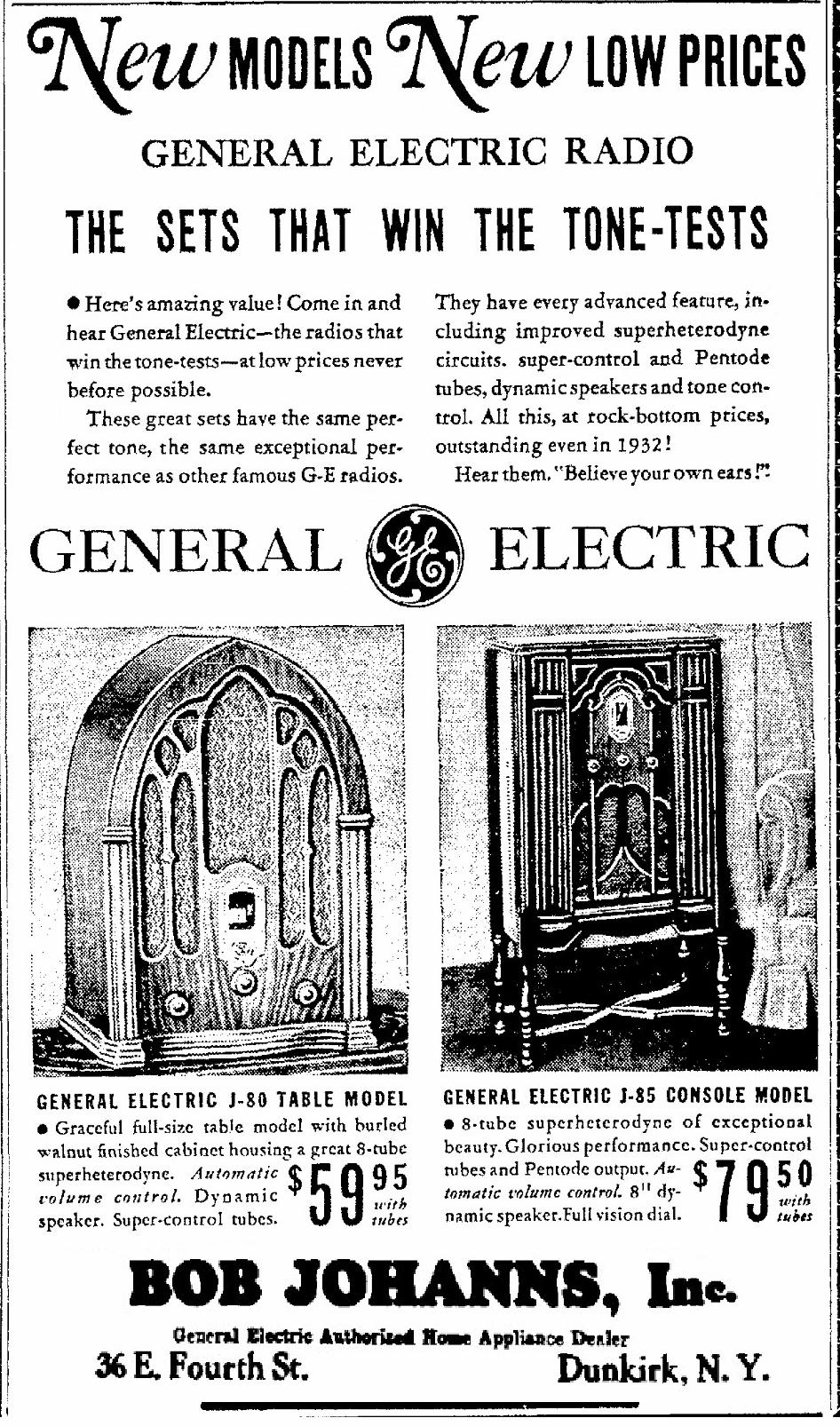
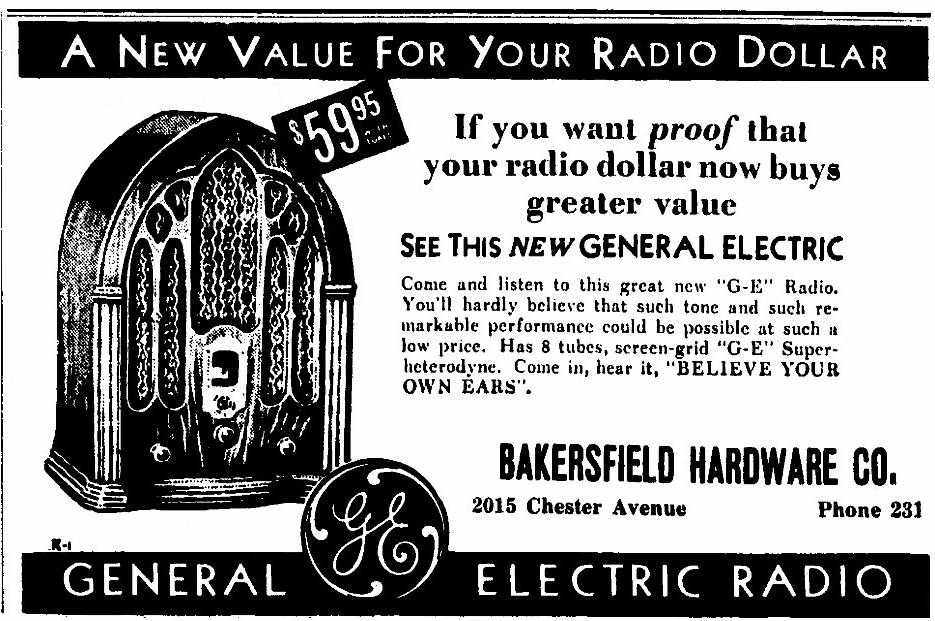
East and West, complete with tubes (see ad below). It
started showing up in newspapers the following month.
Later, in the summer of 1932 it was superseded by the
model J-82, having a modified escutcheon and upgraded
circuitry.
Quality of tone was of major importance to the radio buy-
ing public and was conspicuously addressed by most of
the manufacturers in their promotional material. GE was
no exception and in the grey box below is an extract taken
from 1931 GE advertising that reported on a series of
"blind tests" between different manufacturer's models, the
outcome of which overwhelmingly suggested "superiority
of tone" for the GE models.
GE would frequently refer to these tests in their advertis-
ing, adopting the catch phrase "believe your own ears".
It is unclear exactly which competitors models were comp-
ared and how the tests were conducted, though the tests
were organized by GE. However, GE was on the leading
edge when it came to paying attention to many of the des-
ign aspects that contributed to good tone. Their sets em-
bodied large, heavily built electro-dynamic loudspeakers,
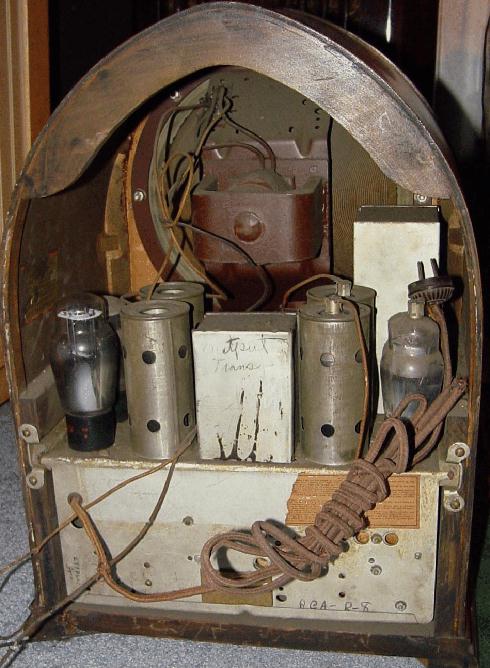
solid cabinets and chassis often completely suspended
by rubber, as is the case for the model J-80 chassis seen
to the lower right. Further information on the tone tests
can be seen on my GE K-62 page.
The J-80 chassis is an 8-tube superheterodyne that tunes
the broadcast band. It features AVC, tone control and
pentode output stage. The chassis is the same as that of
the RCA model R-8 (gothic tombstone) and R-12 (floor
model). The tube line-up is 35 (RF amp), 24A (mixer), 27
(local oscillator), 35 (IF amp), 27 (2nd detector), 27 (AVC),
47 (power pentode) and 80 (rectifier). The AVC uses a
tube dedicated to the AVC function, unlike the superior
Hazeltine circuit, such as used by Philco, that combined
both the AVC and 2nd detector functions into a single
stage (Philco did however add a stage of AF amplification,
referred to as their "detector amplifier").
GE in their 1932 advertising as being "an early English
style compact" with "a new satin finished, two-toned
Gothic cabinet that you'll be proud to own". In my opin-
ion, their description is an understatement, for in real life
this radio portrays a truly stately visual quality that's diffi-
cult to capture in mere words. It's one of my very favorite
cathedral style radios.
The J-80 was announced to the trade in the February
1932 edition of Radio-Retailing, priced at $59.95 in the
East and West, complete with tubes (see ad below). It
started showing up in newspapers the following month.
Later, in the summer of 1932 it was superseded by the
model J-82, having a modified escutcheon and upgraded

circuitry.
Quality of tone was of major importance to the radio buy-
ing public and was conspicuously addressed by most of
the manufacturers in their promotional material. GE was
no exception and in the grey box below is an extract taken
from 1931 GE advertising that reported on a series of
"blind tests" between different manufacturer's models, the
outcome of which overwhelmingly suggested "superiority
of tone" for the GE models.
GE would frequently refer to these tests in their advertis-
ing, adopting the catch phrase "believe your own ears".
It is unclear exactly which competitors models were comp-
ared and how the tests were conducted, though the tests
were organized by GE. However, GE was on the leading
edge when it came to paying attention to many of the des-
ign aspects that contributed to good tone. Their sets em-
bodied large, heavily built electro-dynamic loudspeakers,
solid cabinets and chassis often completely suspended
by rubber, as is the case for the model J-80 chassis seen
to the lower right. Further information on the tone tests
can be seen on my GE K-62 page.
The J-80 chassis is an 8-tube superheterodyne that tunes
the broadcast band. It features AVC, tone control and
pentode output stage. The chassis is the same as that of
the RCA model R-8 (gothic tombstone) and R-12 (floor
model). The tube line-up is 35 (RF amp), 24A (mixer), 27
(local oscillator), 35 (IF amp), 27 (2nd detector), 27 (AVC),
47 (power pentode) and 80 (rectifier). The AVC uses a
tube dedicated to the AVC function, unlike the superior
Hazeltine circuit, such as used by Philco, that combined
both the AVC and 2nd detector functions into a single
stage (Philco did however add a stage of AF amplification,
referred to as their "detector amplifier").
Graceful full-size table model
| "In a series of tests in which a brilliant group of composers, critics and music authorities, passengers aboard the RMS Berengaria, Roxy Orchestra, tone experts of Steinway and Sons, the Cincinnati Conservatory of Music and others participated, G-E Radio was selected because of its superior tone quality. In these tests, four leading makes of sets competed. All radios were hidden from the audience by screens. Each trade name was cloaked behind the alias of a number and no one knew what makes were competing. In every case, G-E was preferred by most of the experts and in several cases the vote was practically unanimous". |
| "The most brilliant performance and beauty yet achieved in table model design. Automatic volume control! 8-tube, screen-grid superheterodyne. 2 super control tubes. Pentode output. Floating chassis - rubber mounted. Tone control. 8" dynamic speaker. Handsome Gothic cabinet - with two-tone walnut velvet finish. Dimensions 18 31-32" high, 14" wide, 10 19-32" deep" |
Copyright TubeRadioLand.com

Feb 1932, Radio Retailing, pg 56-57
Mar 1932, Radio
Retailing, pg 47
Retailing, pg 47
Apr 28th 1932, Iowa
Mar 18th 1932, NY
April 19th, 1932, Bakersfield CA