Technical Highlights
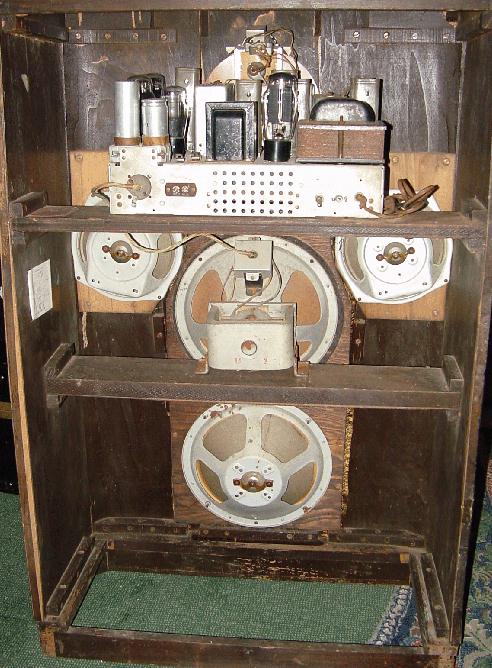
The 116X is a 5-band ac-powered super-heterodyne
using 11 tubes, with RF stage, dual IF amplifiers and, in
he words of Philco, a "High-Fidelity audio system", based
upon a pair of 6A3 triodes operated in "super class A"
push-pull and providing a maximum of 15W undistorted
output. The 6A3 was new for 1936, being a 6.3V version
of the sweet-sounding 2A3 that is still a favorite of
audiophiles today. In addition, the 116X embodies what
Philco described as a "High-Fidelity two-in-one
loudspeaker", mounted inside a sound-diffusing cabinet
that also contained acoustic clarifiers for equalizing
cabinet resonance.
Unlike Philco's top-of-the-line High-Fidelity sets, such as
the 680X from the same model year, the 116X does not
feature variable IF bandwidth control, but it is provisioned
with a comprehensive but conventional 5-point tone
control, having settings of 1) mellow; 2) Brilliant; 3)
Speech; 4) Normal; and 5) noise reducing. Automatic
Bass compensation is applied at low volume settings.
The 5-band coverage is:-
Band 1) 9.7 - 22.5mc (daytime shortwave)
2) 4.1 - 10mc (night time shortwave)
3) 1.5 - 4.1mc (1.5-1.6mc experiment-
al Hi-Fi band, old police
band & amateur)
4) 540 - 1500kc (standard broadcast)
5) 150 - 390kc (long wave)
The tube line up is:- 78 (RF amp), 77 (mixer), 76 (LO), 78
(1st IF), 78 (2nd IF), 37 (2nd detector), 77 (1st af), 42
(driver), 2 off 6A3 (push-pull af output) and 5Z3
(rectifier).
The 116X uses the code 122 chassis versus the code
121 chassis employed by the 116B tombstone radio. The
122 uses a 5Z3 rectifier in place of the 121's type 80 and
6A3 triodes in place of type 42 triode-connected
pentodes, providing higher audio output (15W versus
10W). The schematic can be found here, courtesy of
nostalgiaAir.
The 116X is a 5-band ac-powered super-heterodyne
using 11 tubes, with RF stage, dual IF amplifiers and, in
he words of Philco, a "High-Fidelity audio system", based
upon a pair of 6A3 triodes operated in "super class A"
push-pull and providing a maximum of 15W undistorted
output. The 6A3 was new for 1936, being a 6.3V version
of the sweet-sounding 2A3 that is still a favorite of
audiophiles today. In addition, the 116X embodies what
Philco described as a "High-Fidelity two-in-one
loudspeaker", mounted inside a sound-diffusing cabinet
that also contained acoustic clarifiers for equalizing
cabinet resonance.
Unlike Philco's top-of-the-line High-Fidelity sets, such as
the 680X from the same model year, the 116X does not
feature variable IF bandwidth control, but it is provisioned
with a comprehensive but conventional 5-point tone
control, having settings of 1) mellow; 2) Brilliant; 3)
Speech; 4) Normal; and 5) noise reducing. Automatic
Bass compensation is applied at low volume settings.
The 5-band coverage is:-
Band 1) 9.7 - 22.5mc (daytime shortwave)
2) 4.1 - 10mc (night time shortwave)
3) 1.5 - 4.1mc (1.5-1.6mc experiment-
al Hi-Fi band, old police
band & amateur)
4) 540 - 1500kc (standard broadcast)
5) 150 - 390kc (long wave)
The tube line up is:- 78 (RF amp), 77 (mixer), 76 (LO), 78
(1st IF), 78 (2nd IF), 37 (2nd detector), 77 (1st af), 42
(driver), 2 off 6A3 (push-pull af output) and 5Z3
(rectifier).
The 116X uses the code 122 chassis versus the code
121 chassis employed by the 116B tombstone radio. The
122 uses a 5Z3 rectifier in place of the 121's type 80 and
6A3 triodes in place of type 42 triode-connected
pentodes, providing higher audio output (15W versus
10W). The schematic can be found here, courtesy of
nostalgiaAir.
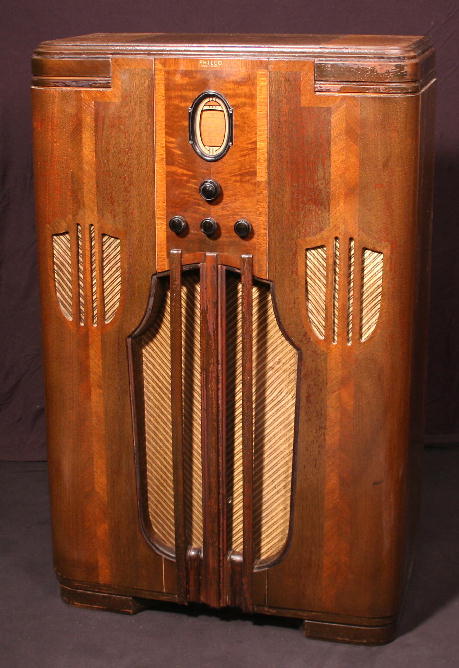
Philco 116X (116) High-Fidelity Console Radio (1935/1936)
| TubeRadioLand:Home > Philco > 116X |
The Philco model 116X console radio was introduced in June of
1935 for the 1936 model year. It listed at $175 and was the latest
in a series of classic Philco 16 /116 sets that had first appeared in
1933. What's more, together with the 680X, it continued Philco's
line of "High-Fidelity" receivers that had debuted the previous
season in the guise of models 200X and 201X. Although the
680X was Philco's top-of-the-line radio for 1936, the 116X was the
season's next-best receiver.
The 116X's cabinet was designed by Benjamin S. Nash and is
described under US patent D101063, filed in Jan 1936. Nash was
also responsible for the set's oval-shaped escutcheon, also used
on most other 1936 Philcos (see patent #D96406).
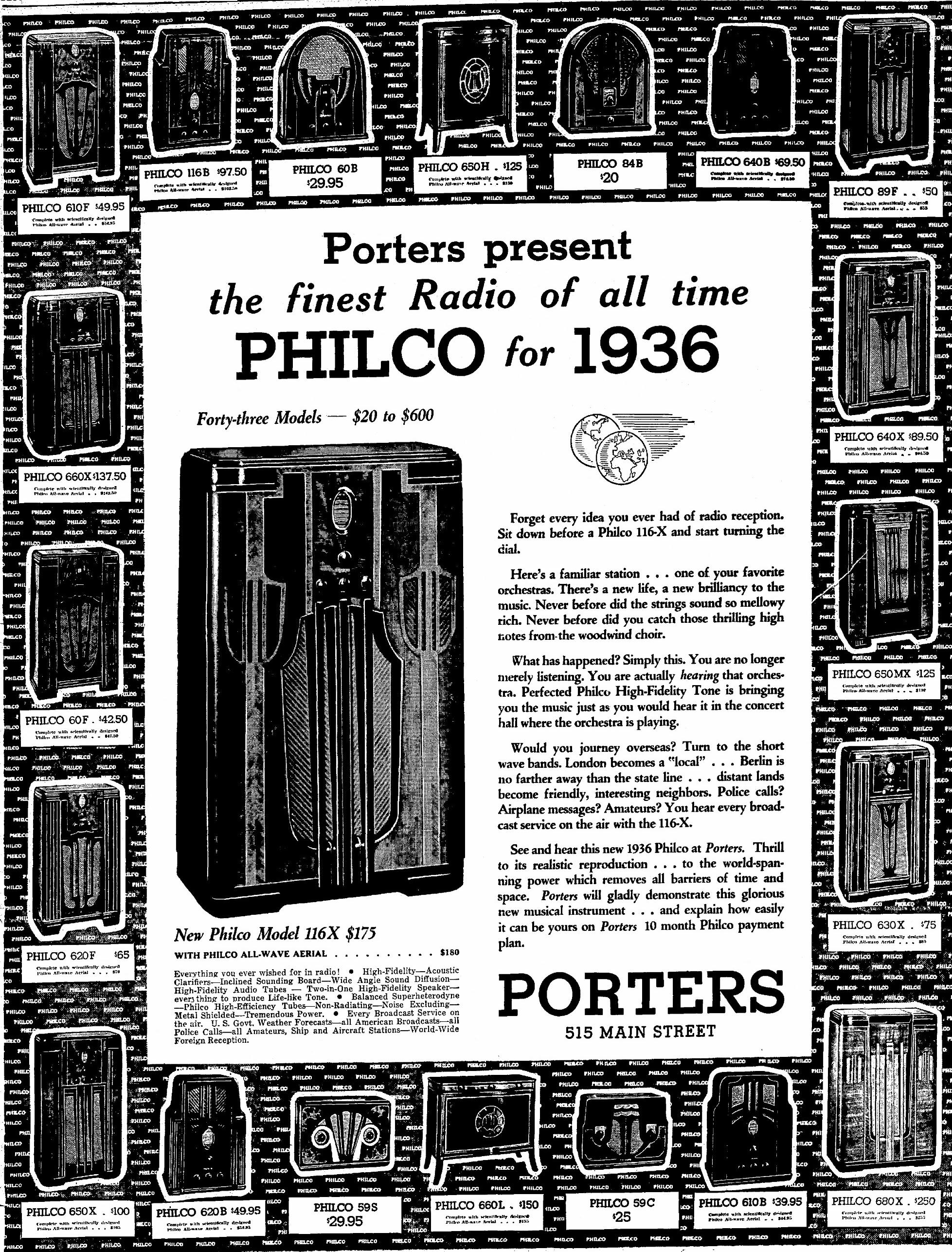
Philco advertising overviewed the 116X features as follows:-
1935 for the 1936 model year. It listed at $175 and was the latest
in a series of classic Philco 16 /116 sets that had first appeared in
1933. What's more, together with the 680X, it continued Philco's
line of "High-Fidelity" receivers that had debuted the previous
season in the guise of models 200X and 201X. Although the
680X was Philco's top-of-the-line radio for 1936, the 116X was the
season's next-best receiver.
The 116X's cabinet was designed by Benjamin S. Nash and is
described under US patent D101063, filed in Jan 1936. Nash was
also responsible for the set's oval-shaped escutcheon, also used
on most other 1936 Philcos (see patent #D96406).
Philco advertising overviewed the 116X features as follows:-
..includes every worthwhile scientific advance in radio reception.
|
| "One feature alone does not make a radio. Philco achieves its marvellous tone, power and foreign reception from the exact matching and balancing of EVERY worthwhile feature!" |
However, the truth of the matter is that the 116X was incapable of
true high-fidelity reproduction, even by 1936 standards, as it did
not offer adjustable IF bandwidths. As a result, the set's audio
was limited to around 4kHz, less than the ~8kHz considered at the
time as the minimum necessary for high-fidelity reproduction. By
comparison, the previous year's 200X/201X and the contempor-
aneous 680X did provide adjustable bandwidths, with an upper
frequency limit extensible to around 7.5kHz. So, we are left
looking upon the 116X as the Philco "poor man's" high-fidelity set
for 1936, and not because it was cheap, since at $175 it wasn't!
In spite of this conclusion, the 116X is a very good sounding radio
with excellent overall performance that provided good value for
money in 1936.
Philco based their claims for the 116X on its "Super Class A"
audio and its loudspeaker system, featuring a "high-fidelity"
driver, acoustic clarifiers, inclined sounding board and a sound
diffusing cabinet. Acoustic clarifiers were a new Philco innovation
for 1936 and their use in the models 116X and the 680X is fully
described in US patent 2059929.
true high-fidelity reproduction, even by 1936 standards, as it did
not offer adjustable IF bandwidths. As a result, the set's audio
was limited to around 4kHz, less than the ~8kHz considered at the
time as the minimum necessary for high-fidelity reproduction. By
comparison, the previous year's 200X/201X and the contempor-
aneous 680X did provide adjustable bandwidths, with an upper
frequency limit extensible to around 7.5kHz. So, we are left
looking upon the 116X as the Philco "poor man's" high-fidelity set
for 1936, and not because it was cheap, since at $175 it wasn't!
In spite of this conclusion, the 116X is a very good sounding radio
with excellent overall performance that provided good value for
money in 1936.
Philco based their claims for the 116X on its "Super Class A"
audio and its loudspeaker system, featuring a "high-fidelity"
driver, acoustic clarifiers, inclined sounding board and a sound
diffusing cabinet. Acoustic clarifiers were a new Philco innovation
for 1936 and their use in the models 116X and the 680X is fully
described in US patent 2059929.
| "The 116X is a true High-Fidelity instrument with a vastly extended musical range which brings out the overtones that identify and distinguish the many and varied musical instruments" |
| "The seven millionth Philco has just been produced... an unparalleled achievement that tells you more about Philco leadership for six successive years than a thousand claims or promises. In celebration Philco dealers are now offering the greatest values in radio history... plus free demonstrations, bigger trade-in allowances and easier terms" "...radio dealers have arranged special window displays for this week, commemorating the production of the seven millionth radio receiver by the company. The seven millionth radio built by the company was a 116X and duplicates of this model, each bearing a medallion designating it as such a duplicate, [are] a feature of the displays" |

PHILCO MODEL 116 SERIES
| "High-Fidelity is indispensable for full musical appreciation. Clarity of tone is equally important. New and exclusive Philco Acoustic Clarifiers automatically prevent unpleasant, barrel-like boom and produce clarity of tone such as you've never heard before. All the extended musical range and clarity of tone created by Philco High-Fidelity and Philco Acoustic Clarifiers are preserved and projected up to ear level by the large area and slope of the famous Philco Inclined Sounding Board" |
Of note is that Philco claimed the 116X to be a "High-Fidelity" set,
just as they had done the year before for models 200X and 201X:-
just as they had done the year before for models 200X and 201X:-
The 116X's Inclined Sounding Board
In the list of 116X features above, reference is made to the use
of an "inclined sounding board" (ISB)*. Its means of embodiment
is however quite different to that of the 112X, one of the first
Philco sets to use the innovation. At a first glance it's easy to
miss the fact that the 116X has an ISB at all! However, close
inspection reveals that the entire 116X front is gently inclined
and that the speaker baffle itself is yet further inclined to this.
These traits are readily apparent from the profile view of the
116X presented in Figures 2 & 3 of Benjamin Nash's patent
(D101063) - see thumnail to the right. That Philco should have
gone to such levels to artfully accommodate the ISB in their
ongoing console line, several years after its introduction, only
goes to show their level of confidence in its technical merits.
*see my 112X page for further insights on Philco's ISB
The 116X's Standard Broadcast Band Coverage (or lack of it!)
It is of note that the 116X's broadcast band coverage extends to
just 1500kc*, which was the band's upper limit when the 116X's
legacy type 16 chassis was introduced in June of 1933. About a
month later, at the North American Radio Conference, the 1500-
1600kc region just above the band was re-designated for the
band's expansion. Then, that December, with the imminent
arrival of high-fidelity receivers, the FRC authorized a number of
experimental "high-fidelity" stations having frequency allocations
within the new space with 20kHz channel spacings. Although this
enlarged band was not made official until March of 1941, radio
set manufacturers scrambled to accommodate it. Most new
Philcos, including all the true "high-fidelity" models starting with
the 200X in 1934, were as a result designed to provide coverage
to at least 1600kc. But this was all too late for the 16/116. The
fact that one had to change bands to receive the high fidelity
stations, along with the set's lack of an IF control, only served to
highlight its pre high-fidelity era legacy. If one wanted a true
"high-fidelity" Philco for 1936, one had no option but to buy the
more expensive 680X.
* see the Band Coverage Table in "Technical Highlights" below right
The 116X's chassis, which was basically that of the 1933 model
16, as it stood in 1936 was at the end of the road. It had served
admirably in one form or another since that time, but its short-
comings rendered it unsuitable for the new generation of
high-end receivers. Philco, by upgrading its audio and through
clever advertising, managed to eek out a successful year of
sales for it in 1936, but that would be it. The next season would
see the introduction of a brand new model 116, based upon an
entirely new 15-tube chassis with true "high-fidelity" capabilities,
at least as they were then understood. That set would be priced
very similarly to the 1936 model and yet would prove to be one of
the best Philco sets ever made.
The Seven Millionth Philco
In early 1936 Philco announced the production of its 7 millionth
radio, which was a model 116X. In celebration of this event the
company ran a media blitz and in cooperation with its dealers,
ran promotions on all Philco models. As the 7 millionth set
completed its trip down the Philco production line, Philadelphia's
mayor, S. Davis Wilson, was present at the plant to place his
official O.K on the radio. He and several of his staff had travelled
to the plant to congratulate the company on their "unprece-
dented record" and "to offer the city's gratitude for having given
steady employment to thousands of Philadelphians and having
added more than $37,000,000 to the city's payroll". On behalf of
the company, the ceremony was attended at the highest level by
James M. Skinner (president, Philadelphia Storage Battery) and
Larry E. Gubb (president, Philco Radio & Television Corp). Later,
this exact 7 millionth set was presented to the Warm Springs
Foundation at yet another ceremony (Wilson visit : "Indiana Evening
Gazette", 3/3/1936, p 7).
Exact replicas of the set were offered for sale to the public with a
commemorative medallion attached, stating it to be an "exact
replica of the seven millionth Philco". Newspaper coverage
promulgating the occasion was extensive and two cuttings, the
first from an advertisement and the second from an
announcement, ran as follows:-
In the list of 116X features above, reference is made to the use
of an "inclined sounding board" (ISB)*. Its means of embodiment
is however quite different to that of the 112X, one of the first
Philco sets to use the innovation. At a first glance it's easy to
miss the fact that the 116X has an ISB at all! However, close
inspection reveals that the entire 116X front is gently inclined
and that the speaker baffle itself is yet further inclined to this.
These traits are readily apparent from the profile view of the
116X presented in Figures 2 & 3 of Benjamin Nash's patent
(D101063) - see thumnail to the right. That Philco should have
gone to such levels to artfully accommodate the ISB in their
ongoing console line, several years after its introduction, only
goes to show their level of confidence in its technical merits.
*see my 112X page for further insights on Philco's ISB
The 116X's Standard Broadcast Band Coverage (or lack of it!)
It is of note that the 116X's broadcast band coverage extends to
just 1500kc*, which was the band's upper limit when the 116X's
legacy type 16 chassis was introduced in June of 1933. About a
month later, at the North American Radio Conference, the 1500-
1600kc region just above the band was re-designated for the
band's expansion. Then, that December, with the imminent
arrival of high-fidelity receivers, the FRC authorized a number of
experimental "high-fidelity" stations having frequency allocations
within the new space with 20kHz channel spacings. Although this
enlarged band was not made official until March of 1941, radio
set manufacturers scrambled to accommodate it. Most new
Philcos, including all the true "high-fidelity" models starting with
the 200X in 1934, were as a result designed to provide coverage
to at least 1600kc. But this was all too late for the 16/116. The
fact that one had to change bands to receive the high fidelity
stations, along with the set's lack of an IF control, only served to
highlight its pre high-fidelity era legacy. If one wanted a true
"high-fidelity" Philco for 1936, one had no option but to buy the
more expensive 680X.
* see the Band Coverage Table in "Technical Highlights" below right
The 116X's chassis, which was basically that of the 1933 model
16, as it stood in 1936 was at the end of the road. It had served
admirably in one form or another since that time, but its short-
comings rendered it unsuitable for the new generation of
high-end receivers. Philco, by upgrading its audio and through
clever advertising, managed to eek out a successful year of
sales for it in 1936, but that would be it. The next season would
see the introduction of a brand new model 116, based upon an
entirely new 15-tube chassis with true "high-fidelity" capabilities,
at least as they were then understood. That set would be priced
very similarly to the 1936 model and yet would prove to be one of
the best Philco sets ever made.
The Seven Millionth Philco
In early 1936 Philco announced the production of its 7 millionth
radio, which was a model 116X. In celebration of this event the
company ran a media blitz and in cooperation with its dealers,
ran promotions on all Philco models. As the 7 millionth set
completed its trip down the Philco production line, Philadelphia's
mayor, S. Davis Wilson, was present at the plant to place his
official O.K on the radio. He and several of his staff had travelled
to the plant to congratulate the company on their "unprece-
dented record" and "to offer the city's gratitude for having given
steady employment to thousands of Philadelphians and having
added more than $37,000,000 to the city's payroll". On behalf of
the company, the ceremony was attended at the highest level by
James M. Skinner (president, Philadelphia Storage Battery) and
Larry E. Gubb (president, Philco Radio & Television Corp). Later,
this exact 7 millionth set was presented to the Warm Springs
Foundation at yet another ceremony (Wilson visit : "Indiana Evening
Gazette", 3/3/1936, p 7).
Exact replicas of the set were offered for sale to the public with a
commemorative medallion attached, stating it to be an "exact
replica of the seven millionth Philco". Newspaper coverage
promulgating the occasion was extensive and two cuttings, the
first from an advertisement and the second from an
announcement, ran as follows:-

Aug 23rd 1935
Copyright TubeRadioLand.com