| TubeRadioLand:Home > Philco > 37-116X |
Philco Model 37-116X High-Fidelity Console Radio (1937)

This Philco 37-116X (37-116) High-Fidelity console radio was
one of two model 116X variants introduced in June of 1936 for
the 1937 model year. The one shown here features standard
(manual) tuning, whereas the other, the 37-116X Deluxe, deb-
uted Philco's "Automatic Tuning", which provided a means for
rapidly locating and tuning in favorite stations. Automatic-tuning,
in its various guises, was a technology about to come of age
and Philco may have been a little uncertain as to how well their
version of it would be received by the radio buying public, so
perhaps as a result they decided to offer the 116X both with
and without the feature. We may never know for sure, but the
Deluxe set was certainly the more heavily advertised and ended
up being a great success, whereas the standard version sold
comparatively few and is a much rarer find today. For sure, the
standard was discontinued in Jan of 1937, after just six months,
whereas the Deluxe continued to be offered through June.
Furthermore, the next season's 38-116XX was available with
automatic tuning only.
The 37-116X was a very different radio to the 1936 116X ,
which was not a true high-fidelity set at all, despite some Philco
advertising claims to the contrary. In addition to new cabinetry
and, in the case of the Deluxe the aforementioned automatic
tuning, the 1937 set received an all-new 15-tube chassis that
provided adjustable IF bandwidths, high-fidelity audio and mag-
netic tuning. In fact, the 37-116X embodied all six elements con-
sidered key by Philco at the time for high-fidelity reproduction
(see box below right).
The 15-tube standard listed at $175, the same as the previous
year's 11-tube 116X. The Deluxe was $20 higher at $195. Both
of these sets represented extremely good value for money.
They were Philco's second to best models for 1937, bettered
only by the 37-690X. Today, of all the 15-tube radios found,
regardless of manufacturer, the 1937 and 1938 Philco 116X
models are those most often encountered, a testimonial indeed
to their great success in the marketplace. According to public
sources, 35,000 1937 and almost 26,000 1938 116Xs were
sold. I know of no other "15-tubers" that came even close!
Philco's Nine Millionth Radio
A brief report on page 29 of the April 1937 edition of Radio
Retailing states that Philco's nine millionth radio set was a 37-
116X Deluxe. The set was presented to Judge Frank Smith of
the Penn Athletic Club by the notorious Philco radio comment-
ator Boake Carter, with Messrs James M. Skinner and Sayre M.
Ramsdell of the Philco Company in attendance.
Model 37-116X Technical Highlights
Overview: The 37-116XX is a 15-tube all-wave AC superhet-
erodyne having five frequency bands with an RF amplifier,
Automatic-Frequency-Control (AFC), two stages of IF amplif-
ication with continuously variable selectivity control and a 15W
High Fidelity audio system with push-pull triode output stage,
cathedral speaker and acoustic clarifiers. The tube line-up is:-
6K7G (RF amp), 6L7G (mixer), 6A8G (LO), 6N7G (reactance
tube), 6K7G (1st IF), 6K7G (2nd IF), 6J5G (2nd detector), 6K7G
(magnetic tuning amp), 6J5G (AVC diode), 6H6G (AFC discr-
iminator), 6J5G (1st audio), 6F6G (triode-connected driver),
6B4G * 2 (triode outputs) and 5U4G (rectifier). The tuning
range is:- 530- 1600kc (band 1), 1580-4750 (2), 4700-7400 (3),
7350-11600 (4) and 11500-18200 (5).
The code 121 chassis, with shadowmeter, was used for the 37-
116X Standard model and the code 122 chassis, with Automatic-
Tuning, for the 37-116X Deluxe. The schematics may be obtain-
ed here, courtesy of NostalgiaAir.
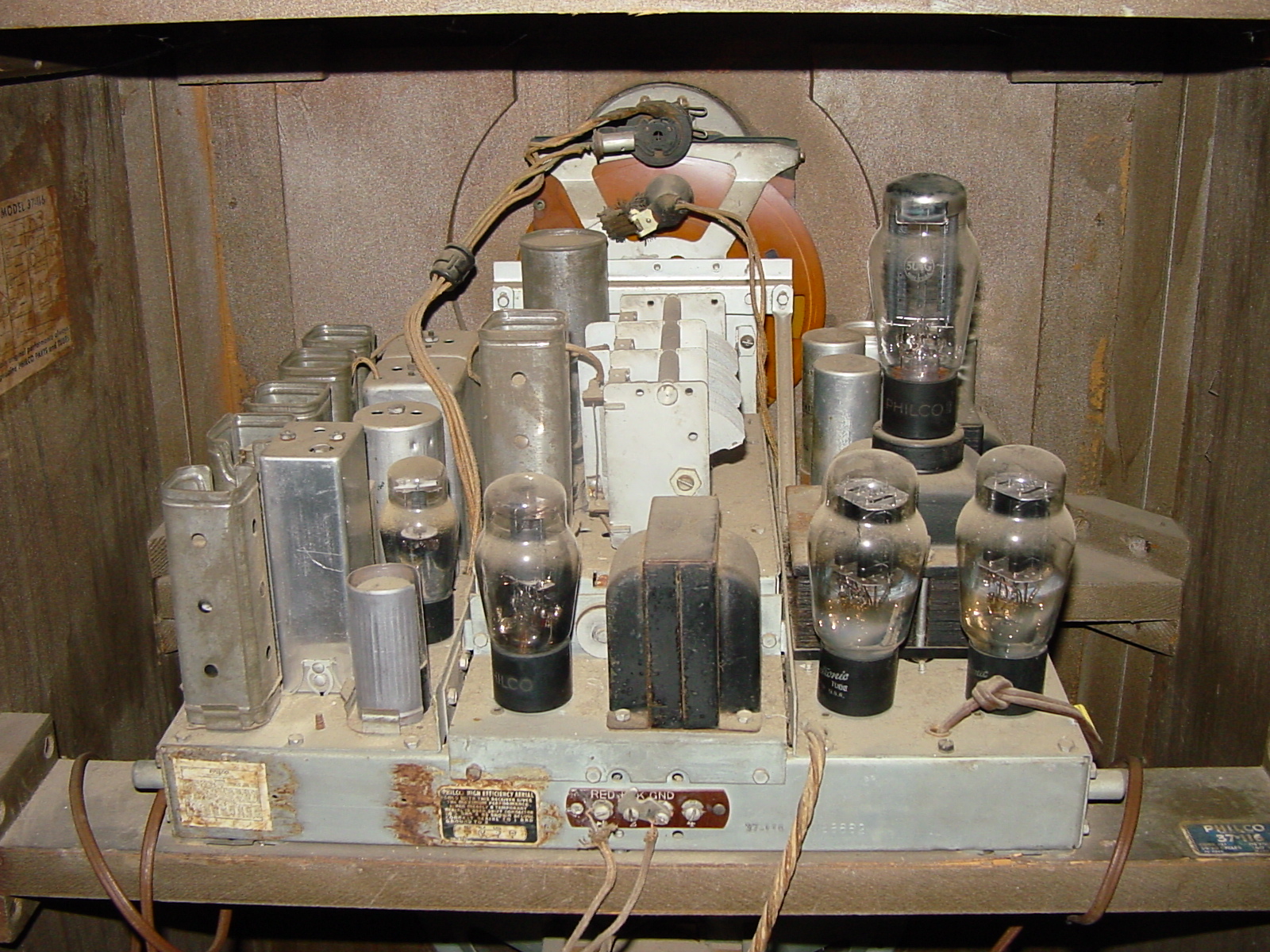
Acoustic Clarifiers: The 37-116X utilizes three 6.25" Acoustic
Clarifiers (see rear photos, this page), designed to eliminate
"barrel-like boom" and produce "clarity of tone beyond all prev-
ious radio experience". These passive devices had been intro-
duced the previous season for the 116X and 680X models. At
that same time, Philco had dispensed with their echo-absorb-
ing-screen, perhaps feeling that it had been made redundant as
a result of the new development. The 37-116X and other 1937
models continued this trend; no screen is or was fitted to the
rear of their cabinets. Interestingly, for 1938 Philco re-introduc-
ed duced rear screens for many of their models, such as the
38-116XX. However, they were advertised as fulfilling a purely
protective role, serving no acoustic purpose, unlike their
predecessors.
Wide-Angle Diffusion: Following another trend, one which
began with the 200/201X in 1934, the 37-116X incorporated
"Wide-angle Sound Diffusion", designed to more evenly dist-
ribute notes on the musical scale throughout the room, less-
ening the beaming effect of the loudspeaker, especially at the
higher frequencies. In their advertising, Philco stated "no longer
visible but there just the same. Built-in, sound spreading trunc-
ated cone back of the grille cloth, in front of the speaker". The
statement is a little curious, given that on none of their models
are diffuser elements evident from the exterior of the cabinets,
other than perhaps the vertical wooden slats in front of the
speaker baffles visible on all the models.
Foreign Tuning System: The 37-116X incorporates Philco's
much touted "Foreign Tuning System" and "Spread-Band Dial",
and, like most 1937 Philcos, it was designed to use their "High-
Efficiency Aerial". One Philco brochure, intended for dealers,
even went so far as to advise that all sets equipped with the
foreign tuning system were to be "sold only with Philco High-
Efficiency Aerial to insure greatest foreign reception". However, the
price of the aerial was not included in listed retail prices, so
whether this statement represented absolute policy or merely a
wish on the part of Philco is unknown. The foreign tuning
system was designed to match the input of the receiver to the
high-efficiency aerial on each band. It was described as "an
absolutely essential measure" that "actually doubles the foreign
stations you can hear and enjoy". Philco advertised that
stations on the 116X Deluxe were spread 6 times further apart
than usual (5 times on the manual tuning version).
For details of other aspects of Philco High-Fidelity, see my
200/201X, 116X, 680X, 37-690X, 38-116X and 38-690XX pages.
For further information on Philco Automatic Tuning and
Magnetic Tuning (AFC) see my "Philco Automatic Tuning and
Automatic-Frequency-Control" page.
one of two model 116X variants introduced in June of 1936 for
the 1937 model year. The one shown here features standard
(manual) tuning, whereas the other, the 37-116X Deluxe, deb-
uted Philco's "Automatic Tuning", which provided a means for
rapidly locating and tuning in favorite stations. Automatic-tuning,
in its various guises, was a technology about to come of age
and Philco may have been a little uncertain as to how well their
version of it would be received by the radio buying public, so
perhaps as a result they decided to offer the 116X both with
and without the feature. We may never know for sure, but the
Deluxe set was certainly the more heavily advertised and ended
up being a great success, whereas the standard version sold
comparatively few and is a much rarer find today. For sure, the
standard was discontinued in Jan of 1937, after just six months,
whereas the Deluxe continued to be offered through June.
Furthermore, the next season's 38-116XX was available with
automatic tuning only.
The 37-116X was a very different radio to the 1936 116X ,
which was not a true high-fidelity set at all, despite some Philco
advertising claims to the contrary. In addition to new cabinetry
and, in the case of the Deluxe the aforementioned automatic
tuning, the 1937 set received an all-new 15-tube chassis that
provided adjustable IF bandwidths, high-fidelity audio and mag-
netic tuning. In fact, the 37-116X embodied all six elements con-
sidered key by Philco at the time for high-fidelity reproduction
(see box below right).
The 15-tube standard listed at $175, the same as the previous
year's 11-tube 116X. The Deluxe was $20 higher at $195. Both
of these sets represented extremely good value for money.
They were Philco's second to best models for 1937, bettered
only by the 37-690X. Today, of all the 15-tube radios found,
regardless of manufacturer, the 1937 and 1938 Philco 116X
models are those most often encountered, a testimonial indeed
to their great success in the marketplace. According to public
sources, 35,000 1937 and almost 26,000 1938 116Xs were
sold. I know of no other "15-tubers" that came even close!
Philco's Nine Millionth Radio
A brief report on page 29 of the April 1937 edition of Radio
Retailing states that Philco's nine millionth radio set was a 37-
116X Deluxe. The set was presented to Judge Frank Smith of
the Penn Athletic Club by the notorious Philco radio comment-
ator Boake Carter, with Messrs James M. Skinner and Sayre M.
Ramsdell of the Philco Company in attendance.
Model 37-116X Technical Highlights
Overview: The 37-116XX is a 15-tube all-wave AC superhet-
erodyne having five frequency bands with an RF amplifier,
Automatic-Frequency-Control (AFC), two stages of IF amplif-
ication with continuously variable selectivity control and a 15W
High Fidelity audio system with push-pull triode output stage,
cathedral speaker and acoustic clarifiers. The tube line-up is:-
6K7G (RF amp), 6L7G (mixer), 6A8G (LO), 6N7G (reactance
tube), 6K7G (1st IF), 6K7G (2nd IF), 6J5G (2nd detector), 6K7G
(magnetic tuning amp), 6J5G (AVC diode), 6H6G (AFC discr-
iminator), 6J5G (1st audio), 6F6G (triode-connected driver),
6B4G * 2 (triode outputs) and 5U4G (rectifier). The tuning
range is:- 530- 1600kc (band 1), 1580-4750 (2), 4700-7400 (3),
7350-11600 (4) and 11500-18200 (5).
The code 121 chassis, with shadowmeter, was used for the 37-
116X Standard model and the code 122 chassis, with Automatic-
Tuning, for the 37-116X Deluxe. The schematics may be obtain-
ed here, courtesy of NostalgiaAir.
Acoustic Clarifiers: The 37-116X utilizes three 6.25" Acoustic
Clarifiers (see rear photos, this page), designed to eliminate
"barrel-like boom" and produce "clarity of tone beyond all prev-
ious radio experience". These passive devices had been intro-
duced the previous season for the 116X and 680X models. At
that same time, Philco had dispensed with their echo-absorb-
ing-screen, perhaps feeling that it had been made redundant as
a result of the new development. The 37-116X and other 1937
models continued this trend; no screen is or was fitted to the
rear of their cabinets. Interestingly, for 1938 Philco re-introduc-
ed duced rear screens for many of their models, such as the
38-116XX. However, they were advertised as fulfilling a purely
protective role, serving no acoustic purpose, unlike their
predecessors.
Wide-Angle Diffusion: Following another trend, one which
began with the 200/201X in 1934, the 37-116X incorporated
"Wide-angle Sound Diffusion", designed to more evenly dist-
ribute notes on the musical scale throughout the room, less-
ening the beaming effect of the loudspeaker, especially at the
higher frequencies. In their advertising, Philco stated "no longer
visible but there just the same. Built-in, sound spreading trunc-
ated cone back of the grille cloth, in front of the speaker". The
statement is a little curious, given that on none of their models
are diffuser elements evident from the exterior of the cabinets,
other than perhaps the vertical wooden slats in front of the
speaker baffles visible on all the models.
Foreign Tuning System: The 37-116X incorporates Philco's
much touted "Foreign Tuning System" and "Spread-Band Dial",
and, like most 1937 Philcos, it was designed to use their "High-
Efficiency Aerial". One Philco brochure, intended for dealers,
even went so far as to advise that all sets equipped with the
foreign tuning system were to be "sold only with Philco High-
Efficiency Aerial to insure greatest foreign reception". However, the
price of the aerial was not included in listed retail prices, so
whether this statement represented absolute policy or merely a
wish on the part of Philco is unknown. The foreign tuning
system was designed to match the input of the receiver to the
high-efficiency aerial on each band. It was described as "an
absolutely essential measure" that "actually doubles the foreign
stations you can hear and enjoy". Philco advertised that
stations on the 116X Deluxe were spread 6 times further apart
than usual (5 times on the manual tuning version).
For details of other aspects of Philco High-Fidelity, see my
200/201X, 116X, 680X, 37-690X, 38-116X and 38-690XX pages.
For further information on Philco Automatic Tuning and
Magnetic Tuning (AFC) see my "Philco Automatic Tuning and
Automatic-Frequency-Control" page.
Philco High-Fidelity Tone gives you sheer, thrilling realism!.

| "The new Philco 1937 line aims at true high fidelity reception, a term that has been used somewhat loosely in the radio industry, but which actually means absolutely true, pure tone reproduction over the entire musical scale from the highest to the lowest notes. It is achieved by combining every scientific advance in radio into a complete system, including a specially designed audio circuit and audio tubes. Six major features include fifteen watts of power which make it possible to bring in every note clearly and distinctly at any volume; the inclined sounding board, which directs the high notes up to ear level in perfect balance with the bass notes; wide angle sound diffusion, which spreads the sound evenly to all parts of the room, additional acoustic clarifiers which do away with barrel-like booming resulting from the distortion of the low notes and absorb cabinet resonance; the tone control knob, which makes it possible for the listener to emphasize either high or low notes as he desires; and the auditorium speaker, which is in effect two speakers, one desgined to carry very high notes and the other to reproduce low notes" |

| "One of the greatest developments for the improvement of foreign and American reception, magnetic tuning is being demonstrated by Philco dealers. The new feature completely eliminates the tendency of a radio to drift "off frequency" or away from the station tuned in, necessitating constant retuning of the set if finest tone and fullest power are to be enjoyed. By means of magnetic tuning the station that is being received is kept perfectly tuned at all times, thus enabling the listener to enjoy the fullest power and tone. Once a station is tuned-in with magnetic tuning in operation, no further attention is necessary and the listener may listen to hour after hour of entertainment without touching the radio. Magnetic tuning works similar to the manner in which a magnet pulls metallic object toward it. The minute a new radio is tuned close to the frequency of any strong station, either at home or abroad, magnetic tuning goes into operation, establishing the exact frequency of the station and holding the set there. It eliminates all possibility of poor tone quality due to inaccurate tuning" |
|
The radio all America knows by name...and Model Number

| "The 116X cabinet has taken on new beauty. Here is a radio whose appearance proclaims its function with units housed so skillfully that the set is as superb in appearance as it is in performance. The finest of butt walnut is matched with figured and pin-stripe walnut, delicately enhanced by two narrawood inlays around the top of the curved ends. Darker toned woods in shaped forms contrast with the smoothly flowing lines of the fine hand-rubbed cabinet" |
| 116X... in a superb new cabinet... |
Copyright TubeRadioLand.com