| TubeRadioLand:Home > Philco > 16B |
Even though this set marked the end of the line for the
model 16 tabletops, its outstanding legacy would continue
on into the 1936 season in the guise of the 116B.
Today, this highly collectible model is quite difficult to find
and I consider myself fortunate to have come by this one.
model 16 tabletops, its outstanding legacy would continue
on into the 1936 season in the guise of the 116B.
Today, this highly collectible model is quite difficult to find
and I consider myself fortunate to have come by this one.
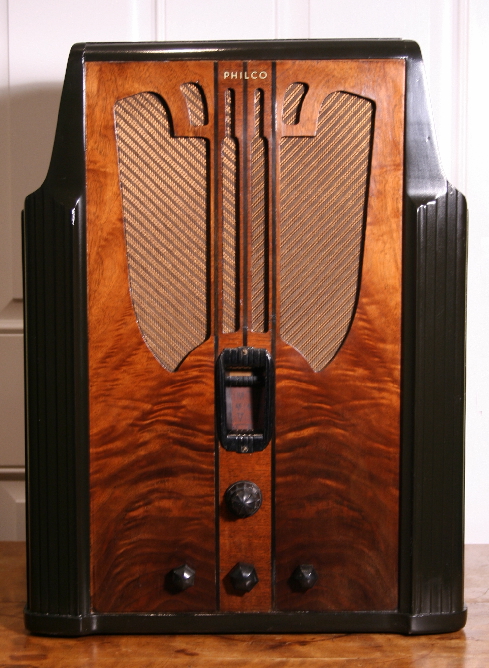
Philco Model 16B Shouldered Tombstone Radio (1935)
This is the fourth and final set in the series of remarkable
Philco model 16 Baby Grand (16B) table radios, the first
of which appeared in June of 1933. This version was
introduced in January of 1935 at a price of $95. It was one
of several new "shouldered tombstone" models that Philco
unveiled mid-way through their 1935 model season, along
with a number of other new and upgraded sets, at a
"showing" held in New York's Hotel McAlpin.
In my opinion, its butterfly-shaped grille, set into a front
panel of highly figured butt walnut and tastefully offset
with contrasting trim, conveys a sense of unimposing yet
elegant simplicity. But let this unassuming facade fool you
not, for it masks one of the era's most powerful and very
best performing tabletop radios.
The features offered by the 16B were advertised in 1935
as:-
Philco model 16 Baby Grand (16B) table radios, the first
of which appeared in June of 1933. This version was
introduced in January of 1935 at a price of $95. It was one
of several new "shouldered tombstone" models that Philco
unveiled mid-way through their 1935 model season, along
with a number of other new and upgraded sets, at a
"showing" held in New York's Hotel McAlpin.
In my opinion, its butterfly-shaped grille, set into a front
panel of highly figured butt walnut and tastefully offset
with contrasting trim, conveys a sense of unimposing yet
elegant simplicity. But let this unassuming facade fool you
not, for it masks one of the era's most powerful and very
best performing tabletop radios.
The features offered by the 16B were advertised in 1935
as:-
| "The finest, most powerful table model ever built, in an exquisite new cabinet of choice hand-rubbed woods" |
- Super Class-A audio system
- Shadow tuning
- Bass compensation
- Philco simplified fast and slow
motion tuning - Automatic Volume Control
- Four point Tone Control
- Four tuning bands
- Illuminated station recording
dial - Philco High-Efficiency tubes
Tune in the world with this new Philco Baby Grand!
Technical Details
This version of the 16B tunes from 540 to 22,500 kc in
four ranges. It's an ac-powered super-heterodyne with the
11-tube line-up:- 78 (RF amp), 77 (mixer), 76 (LO), 78
(1st IF), 78 (2nd IF), 37 (2nd det/AVC), 77 (1st AF), 42
(AF driver), 2 * 42 (push-pull AF) and 80 (rectifier). See
also my 16RX, 16B Art Deco tombstone, 16B cathedral,
16L, 16X & 16X pages. Schematic. Note that this table
model uses the code 125 chassis whilst a code 126/127
chassis, with a 5Z3 rectifier, was employed for the updat-
ed floor models.
Overview of Major Circuit Changes relative to
First Model 16
The second and later models in the series of 16B tomb-
stone radios featured a number of circuit changes relative
to the original, perhaps the most significant of which was
the addition of a tuned RF amplifier, which improved the
set's sensitivity and noise figure. Possibly as a concession
to the additional waveband switching complexity with this
new stage, the Philco designers reduced the number of
wavebands from five to four, while keeping frequency
coverage approximately the same as for the early model.
To keep the tube count at eleven, the squelch (QAVC)
tube was eliminated, though as it turns out Philco was not
alone among manufacturers in doing this*. Squelch was
designed to eliminate background noise while tuning bet-
ween stations and it required the establishment of a
somewhat arbitrary "quieting" or cut-off level, set using a
potentiometer at the rear of the chassis. In practice this
adjustment proved difficult to achieve with any degree of
consistency, as noise conditions varied significantly from
one installation to another. The squelch also had the
unfortunate characteristic of suddenly muting or "chopp-
ing up" the audio from a desired station if that station
experienced momentary signal fades. Even though a
toggle switch was provided on the side of the sets to turn
on or off the squelch to overcome these shortcomings,
the fact that a tube was now needed for the RF stage
meant that squelch simply had to go! The side toggle
switch was however retained for use as a bass boost
on/off control.
Given the addition of an RF amplifier, Philco was able to
improve the automatic-volume-control (AVC). The first
generation 16, with no RF amp, had AVC applied to the
mixer and both IF stages, with the 2nd IF controlled only
partially. The application of AVC to the final (2nd) IF stage
was generally known at the time to have a detrimental
effect on tone quality, contributing to a phenomena
known as "modulation rise", responsible for serious audio
distortion on strong local stations. The later designs there-
fore eliminated the application of AVC to the 2nd IF amp,
which now ran with fixed bias, and applied it only to the RF
and first IF amplifiers. This practice would continue to be
followed by Philco in the design of their larger sets for
many years.
*McMurdo Silver, "1934 Laboratory-Built Super", Radio
News and The Shortwave, Nov 1933
This version of the 16B tunes from 540 to 22,500 kc in
four ranges. It's an ac-powered super-heterodyne with the
11-tube line-up:- 78 (RF amp), 77 (mixer), 76 (LO), 78
(1st IF), 78 (2nd IF), 37 (2nd det/AVC), 77 (1st AF), 42
(AF driver), 2 * 42 (push-pull AF) and 80 (rectifier). See
also my 16RX, 16B Art Deco tombstone, 16B cathedral,
16L, 16X & 16X pages. Schematic. Note that this table
model uses the code 125 chassis whilst a code 126/127
chassis, with a 5Z3 rectifier, was employed for the updat-
ed floor models.
Overview of Major Circuit Changes relative to
First Model 16
The second and later models in the series of 16B tomb-
stone radios featured a number of circuit changes relative
to the original, perhaps the most significant of which was
the addition of a tuned RF amplifier, which improved the
set's sensitivity and noise figure. Possibly as a concession
to the additional waveband switching complexity with this
new stage, the Philco designers reduced the number of
wavebands from five to four, while keeping frequency
coverage approximately the same as for the early model.
To keep the tube count at eleven, the squelch (QAVC)
tube was eliminated, though as it turns out Philco was not
alone among manufacturers in doing this*. Squelch was
designed to eliminate background noise while tuning bet-
ween stations and it required the establishment of a
somewhat arbitrary "quieting" or cut-off level, set using a
potentiometer at the rear of the chassis. In practice this
adjustment proved difficult to achieve with any degree of
consistency, as noise conditions varied significantly from
one installation to another. The squelch also had the
unfortunate characteristic of suddenly muting or "chopp-
ing up" the audio from a desired station if that station
experienced momentary signal fades. Even though a
toggle switch was provided on the side of the sets to turn
on or off the squelch to overcome these shortcomings,
the fact that a tube was now needed for the RF stage
meant that squelch simply had to go! The side toggle
switch was however retained for use as a bass boost
on/off control.
Given the addition of an RF amplifier, Philco was able to
improve the automatic-volume-control (AVC). The first
generation 16, with no RF amp, had AVC applied to the
mixer and both IF stages, with the 2nd IF controlled only
partially. The application of AVC to the final (2nd) IF stage
was generally known at the time to have a detrimental
effect on tone quality, contributing to a phenomena
known as "modulation rise", responsible for serious audio
distortion on strong local stations. The later designs there-
fore eliminated the application of AVC to the 2nd IF amp,
which now ran with fixed bias, and applied it only to the RF
and first IF amplifiers. This practice would continue to be
followed by Philco in the design of their larger sets for
many years.
*McMurdo Silver, "1934 Laboratory-Built Super", Radio
News and The Shortwave, Nov 1933
Restoration
I had been looking for this model for some time when I saw
this one at the Westford, MA, Radio show in Feb of 2007.
However, it was in very dilapidated condition and I initially
passed it by (as did numerous others!). As the show pro-
gressed however, I decided to buy it as a restoration pro-
ject, especially once a $10 sticker appeared on its front!
The thumbnails below tell the story of the set as found
and at various points during the restoration.
Over a period of a few months, I dis-assembled the radio,
stripped off the old finish, which included an ugly, flaking
coat of paint and re-glued the panels, all of which were
seriously de-laminated and buckled as a result of long-
term moisture exposure. In re-building the panels, I first
completely separated the layers of ply and then re-built
each panel layer by layer. At each step, while the glue
was drying the panel was securely clamped between
heavy boards in order to straighten it. A sheet of replace-
ment walnut veneer was used on the top panel as much
of the original was missing. I set aside this original as a
color reference for the re-finishing process. Finally, once
a couple of small veneer patches had been made to the
front panel, the cabinet was re-assembled. To preserve
its structural integrity, the original nails and screws, clean-
ed of rust, were re-inserted just where I had found them to
begin with. Other than the replacement sheet of veneer
on the top, all pieces of the cabinet remain original.
A grain filler was applied to the front and top and the case
was re-finished using toning and clear lacquers. Dark wal-
nut toner was used for the dark areas while the front pan-
el was lightly toned using medium brown walnut. I used
the traces of finish seen on the original top sheet of ven-
eer (that I had set aside) as well as my original "as found"
photos of other areas as a guide to the choice of toning
lacquer used.
At this point, other than a light cleaning, I haven't restored
the chassis.
I had been looking for this model for some time when I saw
this one at the Westford, MA, Radio show in Feb of 2007.
However, it was in very dilapidated condition and I initially
passed it by (as did numerous others!). As the show pro-
gressed however, I decided to buy it as a restoration pro-
ject, especially once a $10 sticker appeared on its front!
The thumbnails below tell the story of the set as found
and at various points during the restoration.
Over a period of a few months, I dis-assembled the radio,
stripped off the old finish, which included an ugly, flaking
coat of paint and re-glued the panels, all of which were
seriously de-laminated and buckled as a result of long-
term moisture exposure. In re-building the panels, I first
completely separated the layers of ply and then re-built
each panel layer by layer. At each step, while the glue
was drying the panel was securely clamped between
heavy boards in order to straighten it. A sheet of replace-
ment walnut veneer was used on the top panel as much
of the original was missing. I set aside this original as a
color reference for the re-finishing process. Finally, once
a couple of small veneer patches had been made to the
front panel, the cabinet was re-assembled. To preserve
its structural integrity, the original nails and screws, clean-
ed of rust, were re-inserted just where I had found them to
begin with. Other than the replacement sheet of veneer
on the top, all pieces of the cabinet remain original.
A grain filler was applied to the front and top and the case
was re-finished using toning and clear lacquers. Dark wal-
nut toner was used for the dark areas while the front pan-
el was lightly toned using medium brown walnut. I used
the traces of finish seen on the original top sheet of ven-
eer (that I had set aside) as well as my original "as found"
photos of other areas as a guide to the choice of toning
lacquer used.
At this point, other than a light cleaning, I haven't restored
the chassis.
| ||||||||||||||||||||||||||


|


4-band later chassis
PHILCO MODEL 16 SERIES



Complete PHILCO MODEL 16B and 116B series
Copyright TubeRadioLand.com
