| TubeRadioLand:Home > Philco > 16B |
Philco Model 16B Tombstone Radios (1st & 2nd) (1934/1935)

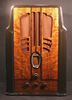
The Philco model 16 Baby Grand (16B) shown upper right
was the first of three styles of model 16 tombstone radio, all
of which are today highly sought after and are legendary for
their style and performance. This Art Deco masterpiece was
introduced in June of 1934 as part of Philco's comprehen-
sive 1935 line-up, which was advertised as encompassing
some 49 scintillating models. It was one of their first tomb-
stone style radios and continued their impressive line of
model 16Bs inaugurated a year earlier, in June of 1933, in
the guise of the model 16B cathedral radio. Its introductory
list price was $89.50.
The set's immediate successor, shown below right, used a
subtly modified cabinet, distinguishable by its more pronoun-
ced peaked top, with a valley running front-to-back in place
of the ridge at the very top, and by the use of a different
style of knobs. It was introduced in the fall of 1934 and in
addition to the cabinet changes it featured updated elect-
ronics (see below). The price however remained the same
at $89.50. A side-by-side comparison of the two versions
can be seen here.
Based on examples of these radios I've seen over an exten-
ded period of time, there appears to be little doubt that
Philco for a while sold versions of the 16B tombstone that
used a mix of cabinet styles and chassis types. I've seen
mostly late cabinets with early chassis, but also a few exam-
ples where the opposite is true. It seems that they elected
to manufacture these intermediate models until their supply
pipeline came into balance. What's also curious is that close
scrutiny of newspaper advertising reveals that ads contin-
ued to feature the earlier 5-band Baby Grands almost exlus-
ively through December of 1934, a month or two after the 4-
band later version had been introduced. Was this just slop-
py advertising? The situation for the model 16X seemed
better, as most ads after early November stated it to have
4-bands. See below left for a selection of ads for the 16B.
There was a third and final set in the lineage of 16B tomb-
stones, introduced in January of 1935, which adopted a
completely new shouldered cabinet, a style that was in vog-
ue for Philco during the 1935 - 1937 time-frame.
All three versions of the 16B tombstones are large, powerful
table radios, each having a 10" loudspeaker and developing
10W of audio output for a full-bodied, room-filling sound.
Technical Details
The first version has 5 wavebands, covering 1) 520 - 1500
kcs, 2) 1.5 - 4.0 mcs, 3) 3.2 - 6.0 mcs, 4) 5.8 - 12.0 mcs &
5) 11.0 - 23 mcs. The 11 tube line-up is:- 77 (mixer), 76
(LO), 78 (1st IF), 78 (2nd IF), 37 (2nd detector/AVC), 77
(1st AF), 42 (triode-connected AF driver), 2 * 42 (triode-
connected push-pull AF), 78 (noise suppression) and 80
(rectifier). There is no RF amplification stage. It uses a large
10" electro-dynamic speaker and a "super class A" output
stage producing 10W. The schematic for the code 121
chassis is available here, courtesy of NostalgiaAir.
The 2nd version added a type 78 tuned RF amp in place of
the noise suppression and reduced the number of bands
from 5 to 4, possibly out of the need to keep the switching in
the new RF stage manageable. The frequency coverage of
the 4-band set is approximately the same as for the 5 at 540
- 22,500 kcs. The tube line-up is:- 78 (RF amp), 77 (mixer),
76 (LO), 78 (1st IF), 78 (2nd IF), 37 (2nd det/AVC), 77 (1st
AF), 42 (triode-connected AF driver), 2 * 42 (triode-connect-
ed push-pull AF) and 80 (rectifier). A discussion of the
changes made to the electronics can be found on my
Shouldered16B page. The schematic for the code 125
chassis used in this model can be found here.
An interesting feature of the early 5-band sets is the inter-
station noise suppression, based around a type 78 tube.
By flicking a switch on the right side of the cabinet a circuit
is activated that mutes the audio if the signal strength is
below a level set using a potentiometer on the rear of the
chassis. When adjusted appropriately, one can tune bet-
ween stations without having to listen to static. The circuit
works very well, though on two model 16s I've restored the
rear wirewound potentiometer was open circuit. Most mod-
ern communication receivers employ this feature, referred
to today as squelch. However Philco abanded it in later
versions of the 16B. In these later sets the side mounted
toggle switch serves as an on/off control for the audio
bass compensation ("loudness").
The small second window immediately above the dial on
both sets is for the shadow meter, which serves as a visual
tuning aid to help the listener tune in a station precisely. It's
a small electro-mechanical device comprising a vane that
rotates in a magnetic field. Illuminated from behind by a fil-
ament lamp, the vane casts a shadow of minimum width
when a station is correctly tuned. Philco first used shadow
meters for their sets in 1932. Other manufacturers had
their own versions of shadow meters or even used moving
coil meters on higher end sets. Zenith initially used a rect-
angular shadow meter (as on the 715 and 835) but by
1937 they had re-designed it as a bulls-eye or target tun-
ing aid (such as on the 10-S-153). For their 1938 line they
abandoned electro-mechanical aids in favor of magic eye
tubes (introduced by RCA back in 1935). Philco never
used eye tubes for their radios, not wishing to pay RCA the
royalties necessary for the privilege, though you can find
eye tubes with the Philco name on them. They sold these
after market for replacement usage in other manufacturer's
radios and for certain of their own items of test equipment!
For more info on the 16 series, see my 16L, 16B cathedral,
16RX, 16X (early '34), 16X (late '34) and late 16B pages.
I bought the first version of the 16B at a flea market early in
the fall of 2001. I spied the seller carrying it in as I entered
and bought it on the spot. Moments later, the usual crowd of
radio buyers had gathered around to take a look - had I
hesitated on the purchase, for even a moment, one of them
would certainly have grabbed it! It was my first model 16 and
the start of a long love affair, for these are definitely among
my favorites of all vintage radios. The seller confessed to
me that at his home he had plugged the radio in and left the
room, only to return and find it smoking. A melted-down 80
rectifier was the result. The moral of this story? Never plug
in old radios until they have been carefully checked over
and serviced. If you simply cannot follow this advise and
cannot resist plugging-in the radio, then never leave it un-
attended! The outcome here could have been so much
worse, both for the radio and the seller!
was the first of three styles of model 16 tombstone radio, all
of which are today highly sought after and are legendary for
their style and performance. This Art Deco masterpiece was
introduced in June of 1934 as part of Philco's comprehen-
sive 1935 line-up, which was advertised as encompassing
some 49 scintillating models. It was one of their first tomb-
stone style radios and continued their impressive line of
model 16Bs inaugurated a year earlier, in June of 1933, in
the guise of the model 16B cathedral radio. Its introductory
list price was $89.50.
The set's immediate successor, shown below right, used a
subtly modified cabinet, distinguishable by its more pronoun-
ced peaked top, with a valley running front-to-back in place
of the ridge at the very top, and by the use of a different
style of knobs. It was introduced in the fall of 1934 and in
addition to the cabinet changes it featured updated elect-
ronics (see below). The price however remained the same
at $89.50. A side-by-side comparison of the two versions
can be seen here.
Based on examples of these radios I've seen over an exten-
ded period of time, there appears to be little doubt that
Philco for a while sold versions of the 16B tombstone that
used a mix of cabinet styles and chassis types. I've seen
mostly late cabinets with early chassis, but also a few exam-
ples where the opposite is true. It seems that they elected
to manufacture these intermediate models until their supply
pipeline came into balance. What's also curious is that close
scrutiny of newspaper advertising reveals that ads contin-
ued to feature the earlier 5-band Baby Grands almost exlus-
ively through December of 1934, a month or two after the 4-
band later version had been introduced. Was this just slop-
py advertising? The situation for the model 16X seemed
better, as most ads after early November stated it to have
4-bands. See below left for a selection of ads for the 16B.
There was a third and final set in the lineage of 16B tomb-
stones, introduced in January of 1935, which adopted a
completely new shouldered cabinet, a style that was in vog-
ue for Philco during the 1935 - 1937 time-frame.
All three versions of the 16B tombstones are large, powerful
table radios, each having a 10" loudspeaker and developing
10W of audio output for a full-bodied, room-filling sound.
Technical Details
The first version has 5 wavebands, covering 1) 520 - 1500
kcs, 2) 1.5 - 4.0 mcs, 3) 3.2 - 6.0 mcs, 4) 5.8 - 12.0 mcs &
5) 11.0 - 23 mcs. The 11 tube line-up is:- 77 (mixer), 76
(LO), 78 (1st IF), 78 (2nd IF), 37 (2nd detector/AVC), 77
(1st AF), 42 (triode-connected AF driver), 2 * 42 (triode-
connected push-pull AF), 78 (noise suppression) and 80
(rectifier). There is no RF amplification stage. It uses a large
10" electro-dynamic speaker and a "super class A" output
stage producing 10W. The schematic for the code 121
chassis is available here, courtesy of NostalgiaAir.
The 2nd version added a type 78 tuned RF amp in place of
the noise suppression and reduced the number of bands
from 5 to 4, possibly out of the need to keep the switching in
the new RF stage manageable. The frequency coverage of
the 4-band set is approximately the same as for the 5 at 540
- 22,500 kcs. The tube line-up is:- 78 (RF amp), 77 (mixer),
76 (LO), 78 (1st IF), 78 (2nd IF), 37 (2nd det/AVC), 77 (1st
AF), 42 (triode-connected AF driver), 2 * 42 (triode-connect-
ed push-pull AF) and 80 (rectifier). A discussion of the
changes made to the electronics can be found on my
Shouldered16B page. The schematic for the code 125
chassis used in this model can be found here.
An interesting feature of the early 5-band sets is the inter-
station noise suppression, based around a type 78 tube.
By flicking a switch on the right side of the cabinet a circuit
is activated that mutes the audio if the signal strength is
below a level set using a potentiometer on the rear of the
chassis. When adjusted appropriately, one can tune bet-
ween stations without having to listen to static. The circuit
works very well, though on two model 16s I've restored the
rear wirewound potentiometer was open circuit. Most mod-
ern communication receivers employ this feature, referred
to today as squelch. However Philco abanded it in later
versions of the 16B. In these later sets the side mounted
toggle switch serves as an on/off control for the audio
bass compensation ("loudness").
The small second window immediately above the dial on
both sets is for the shadow meter, which serves as a visual
tuning aid to help the listener tune in a station precisely. It's
a small electro-mechanical device comprising a vane that
rotates in a magnetic field. Illuminated from behind by a fil-
ament lamp, the vane casts a shadow of minimum width
when a station is correctly tuned. Philco first used shadow
meters for their sets in 1932. Other manufacturers had
their own versions of shadow meters or even used moving
coil meters on higher end sets. Zenith initially used a rect-
angular shadow meter (as on the 715 and 835) but by
1937 they had re-designed it as a bulls-eye or target tun-
ing aid (such as on the 10-S-153). For their 1938 line they
abandoned electro-mechanical aids in favor of magic eye
tubes (introduced by RCA back in 1935). Philco never
used eye tubes for their radios, not wishing to pay RCA the
royalties necessary for the privilege, though you can find
eye tubes with the Philco name on them. They sold these
after market for replacement usage in other manufacturer's
radios and for certain of their own items of test equipment!
For more info on the 16 series, see my 16L, 16B cathedral,
16RX, 16X (early '34), 16X (late '34) and late 16B pages.
I bought the first version of the 16B at a flea market early in
the fall of 2001. I spied the seller carrying it in as I entered
and bought it on the spot. Moments later, the usual crowd of
radio buyers had gathered around to take a look - had I
hesitated on the purchase, for even a moment, one of them
would certainly have grabbed it! It was my first model 16 and
the start of a long love affair, for these are definitely among
my favorites of all vintage radios. The seller confessed to
me that at his home he had plugged the radio in and left the
room, only to return and find it smoking. A melted-down 80

rectifier was the result. The moral of this story? Never plug
in old radios until they have been carefully checked over
and serviced. If you simply cannot follow this advise and
cannot resist plugging-in the radio, then never leave it un-
attended! The outcome here could have been so much
worse, both for the radio and the seller!
You'll find a new thrill when you listen to programs from London,
Paris, Berlin..
Paris, Berlin..
| "Quiet elegance and attractive simplicity characterize the design of this powerful new Baby Grand. Dark, piano-toned woods, decorated with Butt Walnut and old ivory trim, make it a welcome addition to any room. Hand-rubbed satin finish. Employing the same chassis as the 16X, this distinguished Philco creation gives you marvelous radio performance. Here, in compact form, is a radio that enables its owner to enjoy the finest programs the world has to offer." |
| PHILCO 16B All-Wave Radio $89.50 All Wave World Band, tuning range 520 - 23,000 kilocycles. Offers inter-station noise suppression... undistorted audio system... 11 Philco high-efficiency tubes... in Baby Grand cabinet of dark Butt walnut. |


First version (scroll down for 2nd)
PHILCO MODEL 16 SERIES



Complete PHILCO MODEL 16B and 116B series
Copyright TubeRadioLand.com


Nov 14th 1934, Hammond Indiana
July 1st, Texas
Sept 21st, PA


Dec 19th 1934, Wisconsin
5-band 16B
5-band 16B
Dec 17th 1934, Centralia
Wash. 5-band 16B
Wash. 5-band 16B